Book My Luck
Middle Eastern Protection Symbols: Hamsa, Nazar
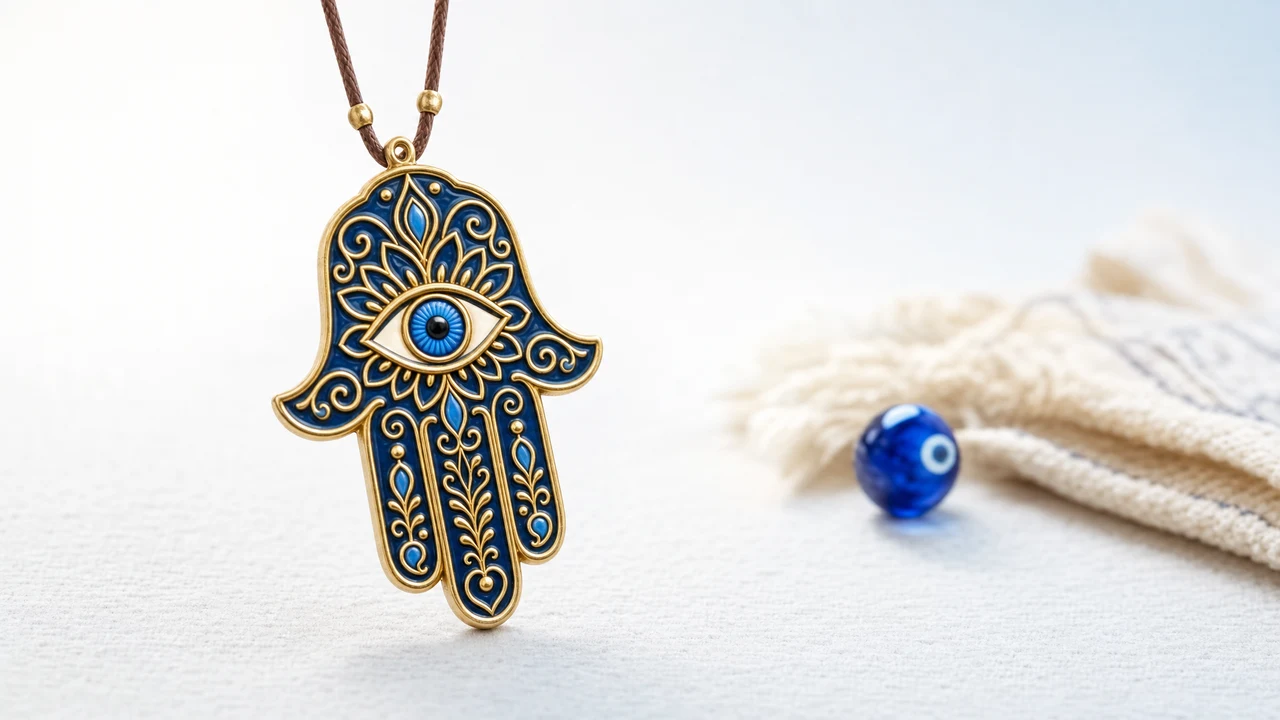
Middle Eastern protection symbols are objects and shapes believed to guard a person, home or business against the evil eye, meaning harm carried by an envious or careless glance. The two you see most are the hamsa, an open hand, and the nazar, a blue glass eye, and they are often hung side by side.
Most guides describe these as decoration. In the cultures they come from, they are working objects with a clear job at the front door.
What are the main Middle Eastern protection symbols?
The idea underneath all of them is the belief in the evil eye. That belief spans Turkey, the Levant, the Gulf, North Africa and far beyond.
The evil eye is not a monster. It is the plain human fact that attention can be heavy, and that envy, even unintended, can feel like a weight on the thing being admired.
Protection symbols answer that with a simple move. They catch the glance first so it never lands on the person or the child or the new shop.
These symbols cross religious lines. You will find the hamsa in Jewish, Muslim and Christian homes across the region, and the blue eye in secular apartments and taxi mirrors alike. The custom is older and wider than any single faith.
The full background on the belief itself is in what the evil eye really means. This piece stays on the objects.
The nazar: the blue eye that watches back
The nazar is the blue glass disc with a dark center, the one that stares. Its whole design is a defense.
The color is not an accident. Blue was rare and precious in the ancient Mediterranean, and it was tied to the sky and to protective power.
The eye shape is the clever part. An eye to meet an eye means the amulet returns the gaze of anyone looking with envy, so the harmful attention bounces off.
You hang it where attention gathers. Over a doorway, on a car mirror, on a baby's clothing, at the entrance to a shop where money and eyes both pass.
The Turkish version, the nazar boncuğu, has its own long story about why the glass is blue and how it is made. If that thread interests you, follow the Turkish evil eye.
The hamsa: an open hand with an eye in the palm
The hamsa is a hand, usually symmetrical, often with an eye set in the center of the palm. The word comes from the Semitic root for "five."
It goes by several names. Jewish tradition calls it the Hand of Miriam; many Muslim communities call it the Hand of Fatima. The shape is shared even when the story attached to it differs.
The open palm does two things at once. A raised hand is the universal gesture for stop, and the eye in the palm keeps watch so nothing slips past.
The direction it faces carries meaning, and people disagree about it in a friendly way. Fingers up is read as a shield that blocks harm; fingers down is read as an invitation for blessing and abundance to pour in.
The deeper piece on that debate, including where to hang each version, is the hamsa hand meaning.
How the hamsa and nazar compare
People often ask which one to choose. The honest answer is that they do different work and are frequently used together, the eye set inside the hand.
Here is each one kept to its real role.
| Symbol | What it is | What it does |
|---|---|---|
| Nazar | A blue glass eye with a dark center | Meets and deflects an envious glance |
| Hamsa | An open hand, often with an eye in the palm | Blocks harm with a raised palm, watches with the eye |
| The two together | An eye set inside the hand | Layered defense, the classic pairing |
If you can only pick one for a doorway, the nazar is the lighter, plainer choice and reads clearly to almost everyone. If you want something with more presence and a story to explain, the hamsa carries both. There is no wrong answer, and many homes use both.
Notice that no product is being ranked here. This is a comparison of symbols, the way you would compare a lock and a doorbell. Each has a purpose.
Where do you hang a hamsa or a nazar?
You hang them where attention and traffic meet, because that is where the belief says harm arrives. The threshold is the classic spot.
For a home, that means the front door, the entrance hall, or a wall visible as you step inside. At the point of entry is the rule of thumb across the region, since the eye that matters is the one cast as someone comes and goes.
Other traditional spots follow the same logic. A car mirror guards the driver, a baby's clothing guards the child, and a spot near the till guards a shop where money and glances both change hands.
The hamsa often goes higher and more central, on a wall or above a doorway, where its open palm faces outward like a raised hand. The nazar tends to go wherever a quick, plain eye is useful, which is why you find it on cords, keys and bracelets as well as walls.
There are a few small customs worth respecting. Some families replace a cracked nazar promptly, reading the crack as the bead having done its work and taken a hit meant for the household.
Using these symbols with respect
These are living traditions, not vintage props. A few small habits keep the use honest.
Learn the origin before you hang the object. Know the name of what you are using, and you will use it with more care.
Do not treat a sacred hand or a protective eye as a costume or a joke. The families who hang these mean them, and the respectful move is to mean yours too.
Ask before assuming a version is universal. The Hand of Miriam and the Hand of Fatima share a shape but carry different stories, and getting the name right in the right company is a small courtesy that goes a long way.
Here is the line that matters for any of them. A protection symbol is a charm, not a promise. It works the way a pre-game ritual works, by marking a threshold and settling the mind, not by controlling what happens on the other side of the door.
For how this same protective instinct appears in Italy, Ireland, Japan and beyond, the wider map is lucky charm meanings around the world.
Where a screen charm fits
The reason these symbols endure is placement at a threshold. The door, the mirror, the entrance, the spot you pass on the way into something.
A screen is a threshold too. It is the door you walk through into the exam, the interview, the call that decides things.
That is the thinking behind hanging a nazar or a hamsa from the top of your Mac screen with Book My Luck. The old placement rule, at the entrance to what matters, still holds, and the symbol still does the one thing it was made to do, which is to catch the eye first. The cost is a one-time price, not a subscription.
FAQ
What is the most common Middle Eastern protection symbol?
The blue nazar eye is the most widespread, seen on doorways, car mirrors and clothing across Turkey, the Levant and the Gulf. The hamsa hand runs a close second and often appears alongside it.
Are the hamsa and the evil eye the same thing?
No. The evil eye is the belief in harm carried by an envious glance. The nazar is the blue amulet that deflects it, and the hamsa is a protective hand that often has an eye set in its palm to do similar work.
Which way should a hamsa face?
Fingers up is read as protection that blocks harm, and fingers down as an invitation for blessing to flow in. Both are traditional, so pick the meaning you want and hang it that way.
Do these symbols belong to one religion?
No. The hamsa and the blue eye appear in Jewish, Muslim and Christian homes across the region and in secular ones too. The custom is older and broader than any single faith.
Can I use a hamsa or nazar if it is not from my culture?
Yes, if you learn its real meaning and treat it with respect rather than as a fashion prop. Naming the origin and using the object as intended is the respectful baseline.
Do Middle Eastern protection symbols actually work?
They protect the way any charm does, by marking a threshold and steadying the person who hung it. Treat them as a reminder and a ritual, not as a guarantee against any specific harm.
Hang one for the moment that matters
Book My Luck hangs a rendered charm from your Mac or Windows screen, with rope physics and manual interaction. Check the current platform release and regional price before buying.
Get Book My Luck →