Book My Luck
Hamsa Hand Meaning: Palm Up or Palm Down?
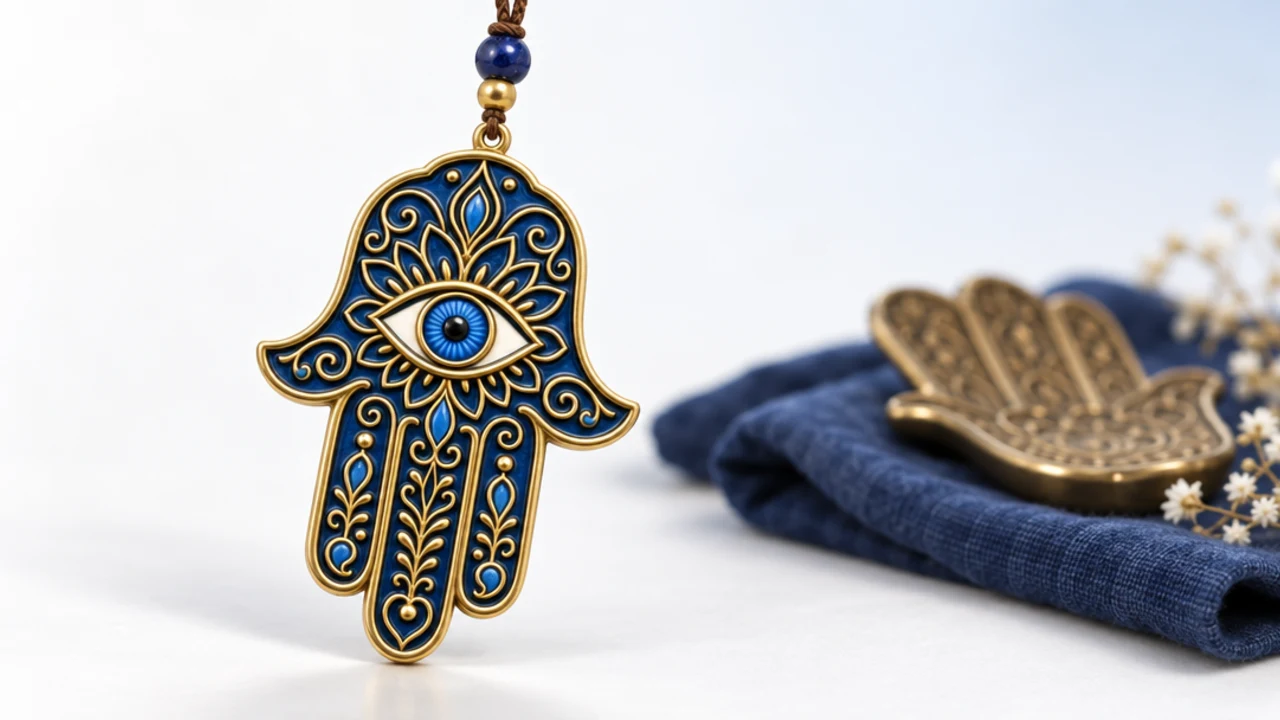
The hamsa hand meaning is protection and blessing: an open palm, often with an eye in the center, believed to shield the wearer from harm and draw in good fortune. Whether you hang it palm up or palm down shifts the emphasis, not the core idea.
Most guides argue that one direction is "correct." In practice both are traditional, and the difference is which side of protection you want to lean into.
What is the hamsa hand meaning?
It is an open right hand shown flat, symmetrical, and often stylized with the two outer fingers curving outward. The name comes from the Semitic root for "five," so hamsa and khamsa both point to the five fingers.
The hamsa hand meaning centers on an open palm that says "stop" to harm while offering a blessing. It is one of the oldest protective symbols across the Middle East and North Africa.
It carries different names by community. Many call it the Hand of Fatima or the Hand of Miriam, which reflects how widely it is shared across faiths in the region.
Hamsa means five, for the five fingers. The core reading is the same everywhere: an open hand that protects and blesses.
Palm up or palm down: what changes?
This is the question people actually ask, so here is the plain version. The direction shifts the emphasis between warding off and inviting in.
Palm down
- Reading: wards off harm and negative energy.
- Feel: a hand held out to stop something.
- Common use: hung at a door as a guard.
Palm up
- Reading: invites good fortune, blessing, and abundance.
- Feel: an open hand ready to receive.
- Common use: worn or hung when you want to draw good things in.
Neither is wrong. Some people even rotate it depending on the season of life they are in, warding off in hard times, inviting in during hopeful ones.
If you are gifting one, either direction is a kind gesture. The meaning is protective in both, and the recipient can hang it whichever way speaks to them.
Why is there an eye in the palm?
The eye you often see in the center is a nazar, the blue evil eye. It adds a second layer of protection, specifically against an envious gaze.
So a hamsa with an eye is really two guards in one object. The hand offers broad protection, and the eye handles the evil eye meaning directly, catching a hostile look.
Not every hamsa has an eye. Plainer versions rely on the hand alone, and both are traditional, so the eye is an addition rather than a requirement.
If envy is your specific worry, choose a hamsa with a nazar in the palm. If you want a broader blessing, a plain open hand does the job.
Hamsa or nazar: which should you choose?
People confuse the two because they often appear together and both guard against harm. They come from overlapping regions and pair naturally.
The short contrast is this. The nazar is focused, and the hamsa is broad.
The nazar boncuğu meaning guide covers the blue bead in detail, including why it is blue and how it is used. Between the two, choose the nazar when your worry is a specific envious gaze, and the hamsa when you want a wider shield and blessing.
Many people simply keep both, or one object that combines them. There is no rule against layering protection.
Does the hamsa hand really work?
Here is the honest line. It is a charm, not a promise, and it will not change a result, a diagnosis, or another person's choices.
Its value is human and real. A hamsa marks care and intention, gives worry a place to rest, and reminds you that someone wanted you protected.
That steadies people before nervous moments, the way any small ritual does. It is closer to a lucky pen than to a cure, and it is honest to say so.
The symbol is ancient and shared across Jewish, Muslim, and other communities, so it deserves plain, respectful description. Precise origins are hard to date, so it is fairer to say the hand is very old and widely held than to fix it to a single time or place.
It is a charm, not a promise. Never treat a hamsa as a medical, financial, or exam guarantee. Its worth is in meaning and steadiness.
The hamsa on your screen
The open hand has moved from doorways to desks. A lucky charm app for Mac can hang a hamsa from the top of your screen, on a cord with real rope physics, so it sways and reacts to your cursor.
The gesture carries over. With Book My Luck you give it a flick, and it settles back into place over your work.
For where the hamsa sits among charms from Turkey, Japan, Italy, and India, the lucky charm meanings around the world guide lines them up with care.
Where do you wear or hang a hamsa?
The hamsa moves easily between the body and the wall. As jewelry it hangs on a necklace, a bracelet, or an anklet, sitting close to the person it protects.
As a home charm it goes by the door, on a wall, or above a bed, much like other threshold guards. The placement follows the same instinct: put the protection where harm is thought to enter, or where the people you love spend their time.
It also appears on everyday objects. Keychains, phone cases, wall hangings, and bookmarks all carry the open hand, which keeps the blessing nearby without ceremony.
Because it reads as protective rather than tied to one occasion, the hamsa suits both quiet daily wear and gift-giving. A new home, a new baby, a new job, or simply a friend heading into something hard.
If you want the hamsa on you rather than on a wall, a small pendant is the most common form. Choose palm up if you want to feel you are inviting good things in.
Is the hamsa the same as the eye alone?
Not quite, though they overlap. The eye alone is the nazar, focused on the envious gaze, while the hamsa is the whole hand offering a broader shield and blessing.
When the two combine, you get both at once. That is why a hamsa with an eye in the palm is so common, since it pairs a wide protection with a targeted one.
Choosing between them comes down to what you want the charm to say. The hand speaks of blessing and warding in general, and the eye speaks specifically to envy.
A note on names
You will see hamsa, khamsa, Hand of Fatima, and Hand of Miriam. These all point to the same open-palm charm, with the different names reflecting the communities that hold it dear.
That shared use is part of what makes the hamsa special. It is a symbol several traditions recognize as their own, which is rare and worth respecting.
The design itself ranges from plain metal outlines to richly decorated pieces set with color and stone. A minimal hamsa suits everyday wear, while an ornate one often marks a home or a gift for an occasion.
Whatever the style, the open palm is the constant. Everything else, the eye, the color, the decoration, is a layer added on top of that one clear gesture of protection.
What does the hamsa hand symbolize?
It symbolizes protection and blessing, shown as an open palm often with an eye in the center. Across the Middle East and North Africa it is worn or hung to shield against harm and invite good fortune.
Should the hamsa face up or down?
Both are traditional. Palm down is commonly read as warding off harm, while palm up is read as inviting good fortune, so choose the direction that matches what you want.
Why does the hamsa have an eye in it?
The eye is a nazar, the blue evil eye, added for protection against an envious gaze. A hamsa with an eye combines a broad shield with a focused one.
Is the hamsa Jewish, Muslim, or something else?
It is shared across several traditions, including Jewish and Muslim communities, which is why it has names like Hand of Miriam and Hand of Fatima. It functions as a widely held protective symbol rather than belonging to one faith.
Can I give a hamsa as a gift?
Yes, it is a warm, protective gesture. Either palm direction is fine, and the recipient can hang it whichever way speaks to their situation.
Does a hamsa hand actually protect you?
It is a charm, not a promise. It marks care and steadies you before a tense moment, and it never claims to change a real outcome you cannot control.
Book My Luck today
Book My Luck is a desktop decoration for macOS 14+ and Windows 10/11. The desktop outside the charm remains clickable. The current Mac and Windows downloads are version 1.0.32, signed by KAK DIGITAL LLC. On Mac, Charm Centre controls size, cord length, placement, displays and motion. Collections and controls can differ between Mac and Windows.
There is no calendar integration, booked-moment scheduler or native-app free trial. Explore the website demo and regional pricing. One key activates one computer at a time; activation and license refresh require internet. Preferences are local, but purchasing, activation and website analytics use online services described in the privacy policy.
Hang one for the moment that matters
Book My Luck hangs a rendered charm from your Mac or Windows screen, with rope physics and manual interaction. Check the current platform release and regional price before buying.
Get Book My Luck →