Book My Luck
Ancient Egyptian Amulets: Scarab, Ankh, Eye
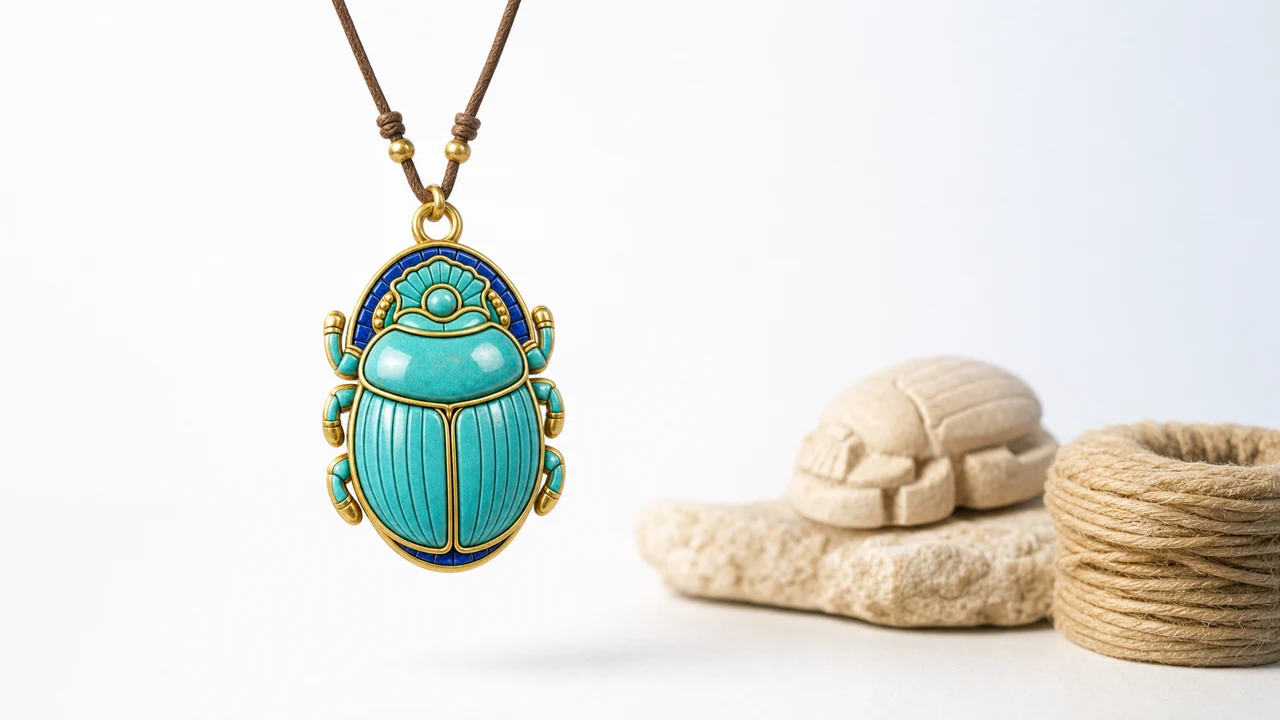
Ancient Egyptian amulets were small carved objects worn or buried to protect a person, invite renewal, or carry them safely into the next life. The three you have almost certainly seen are the scarab, the ankh, and the Eye of Horus, and each one did a different job.
Most write-ups treat them as interchangeable "Egyptian symbols." They were not. Egyptians chose an amulet the way you would choose the right tool for the task in front of you.
What were ancient Egyptian amulets for?
An amulet was a physical stand-in for a wish. You held the shape, and the shape held the meaning.
Egyptians made them from faience, carnelian, lapis, gold and glazed steatite. The material mattered as much as the form, because color carried meaning too.
A shape that held a promise is the simplest way to understand the whole category. A green stone spoke of new growth. A blue-green glaze spoke of the sky and the river.
Amulets showed up everywhere in daily life, not only in tombs. People wore them on cords, sewed them into wrappings, set them in rings, and pressed them into wax seals. The tomb finds survive best, which is why we picture them as funeral objects.
The word we translate as "amulet" comes from roots tied to guarding and carrying. That is the honest center of the idea. You carried a small thing so you would not face the day empty-handed.
Shape and color together spelled out the request. A green stone shaped as new shoots asked for growth; a blue-glazed eye asked for protection; a knot or a pillar asked for stability.
Priests and craftsmen took this seriously enough to write it down. Funerary texts list which amulet went where on the body and what each one was expected to do, which tells you these were considered practical instruments, not jewelry.
The scarab: renewal you could hold
The scarab was the most common of all ancient Egyptian amulets, and it is the one Book My Luck renders as a spread-winged beetle you can hang on your screen. Its meaning starts with an insect and a habit most people find strange until they hear the logic.
The dung beetle rolls a ball of dung across the ground and lays its eggs inside. New beetles then seem to emerge from the ball on their own.
To Egyptian eyes, that looked like life appearing from nothing. They tied it to the sun god Khepri, who was pictured rolling the sun across the sky each dawn.
So the scarab came to mean the sun rising again after the dark. It stood for renewal, for a fresh start, for the confidence that morning always returns.
Heart scarabs were a special case. A larger scarab was placed over the heart of the dead with a text asking the heart not to testify against its owner when the soul was weighed. It was protection at the most vulnerable moment a person could imagine.
If you want the full story of the beetle and how people used it, the deeper piece is what the scarab beetle means. Traders and makers still like it for the same reason the Egyptians did, which is why it turns up again in a lucky charm for trading day.
The ankh and the Eye of Horus
These two are grouped together here because people mix them up, yet they answer very different needs.
The comparison below keeps each amulet to its real job. None of these are ranked against the others, because they were never meant to compete.
Scarab
- Origin: the dung beetle and the sun god Khepri
- Meaning: renewal, rebirth, a new morning
- Worn for: fresh starts, safe passage, courage before change
- Material note: often green or blue-green, the colors of growth and sky
Ankh
- Origin: a looped cross, the hieroglyph for "life"
- Meaning: life itself, and life that continues
- Worn for: vitality, well-being, a blessing on the living
- Material note: carried by gods in tomb art, pressed to the nose to give breath
Eye of Horus
- Origin: the healed eye of the falcon god Horus, injured by Set
- Meaning: protection, healing, wholeness restored
- Worn for: guarding against harm and making broken things whole
- Material note: the wedjat, drawn with a falcon's cheek marking below it
The Eye of Horus deserves one more note, because its logic is beautiful. Horus loses his eye in a fight, and it is restored by another god.
The restored eye becomes a symbol of healing and being made whole again. That is why it guarded the living and the dead alike.
If you like the idea of an amulet but a museum piece feels too heavy for a desk, pick the meaning first and the object second. Choose renewal, protection, or life, then find the shape that carries it. The point is the reminder, not the antiquity.
How Egyptians actually used them day to day
Amulets were not rare or precious for most people. Faience versions were mass-produced in molds and sold at every scale, from cheap glazed beads to fine carved gold.
A person might wear several at once, each covering a different worry. One for protection, one for health, one for luck in a specific task.
That stacking habit is the part that feels modern. It is the same instinct behind carrying a small reminder into a moment that matters, whether that is a talisman, a lucky pen, or a pre-game routine.
Placement followed the worry. An amulet meant to guard the body was worn on the body; one meant to guard a home sat at a threshold; one meant for safe passage was tucked into the wrappings for the journey ahead.
That logic still holds. You put the reminder where the risk lives, which is why the choice of where often mattered as much as what.
Here is the honest line, and it held then as it holds now. An amulet is a charm, not a promise. It works the way a ritual works, by marking the moment and steadying the hand, not by bending an outcome.
Egyptians would likely have agreed with the spirit of that. The amulet did its part; the person still had to do theirs. For how this same instinct shows up across other cultures, the map is lucky charm meanings around the world, and the nearest cousins are covered in Middle Eastern protection symbols.
Which Egyptian amulet should you choose?
Choose the one whose job matches your worry, the way an Egyptian would have. The shape is not the point; the promise behind it is.
If you are starting something and want the nerve to begin, the scarab and its promise of a fresh morning is the natural pick. Traders, founders and anyone facing a reset have leaned on it for exactly that reason.
If you want to guard health or well-being, the ankh is the older answer, since it stands for life itself. And if the fear is harm from outside, whether a rival, a jinx or plain bad odds, the Eye of Horus is the one built to watch and protect.
You do not have to pick only one. Egyptians stacked amulets freely, and there is nothing wrong with a scarab for courage and an Eye of Horus for protection sitting together. What matters is that you know why each one is there.
Where a screen charm fits
The reason ancient Egyptian amulets still speak to us is placement. They sat where the body was, close and constant, so the reminder was always in reach.
A desk is the modern equivalent of that spot. It is where the nervous moments happen, and it is where a small steadying object earns its keep.
That is the idea behind hanging a scarab from the top of your screen. It sways, it catches your eye before a hard task, and it costs a one-time price rather than a museum ticket. The meaning is old; only the surface is new.
FAQ
What is the most common ancient Egyptian amulet?
The scarab beetle is the most common by a wide margin. It stood for renewal and rebirth and was made in every material from cheap faience to solid gold, worn in life and placed with the dead.
What is the difference between the ankh and the Eye of Horus?
The ankh is the hieroglyph for life and signals vitality and continued existence. The Eye of Horus is the healed falcon eye and signals protection and healing. One blesses life, the other guards it.
Were Egyptian amulets only used for the dead?
No. They were part of daily life, worn on cords and rings and pressed into seals, chosen to guard against specific worries. Tomb amulets survive best, which is why the funeral association feels stronger than it was.
What did the scarab symbolize?
The scarab symbolized renewal and the rising sun, linked to the god Khepri who rolled the sun across the sky. It carried the promise that morning, and a fresh start, always comes again.
Do ancient Egyptian amulets bring good luck?
They were meant to protect, renew and bless, which overlaps with what we now call luck. Treat any charm as a way to mark a moment and steady yourself, not as a guarantee of results.
Can I use an Egyptian symbol respectfully today?
Yes, if you learn its real meaning and use it with care rather than as a costume. Naming the origin, as this piece does, is the respectful baseline for any borrowed symbol.
Hang one for the moment that matters
Book My Luck hangs a rendered charm from your Mac or Windows screen, with rope physics and manual interaction. Check the current platform release and regional price before buying.
Get Book My Luck →