Book My Luck
Finnish Himmeli Tradition: Straw, Light, Harvest
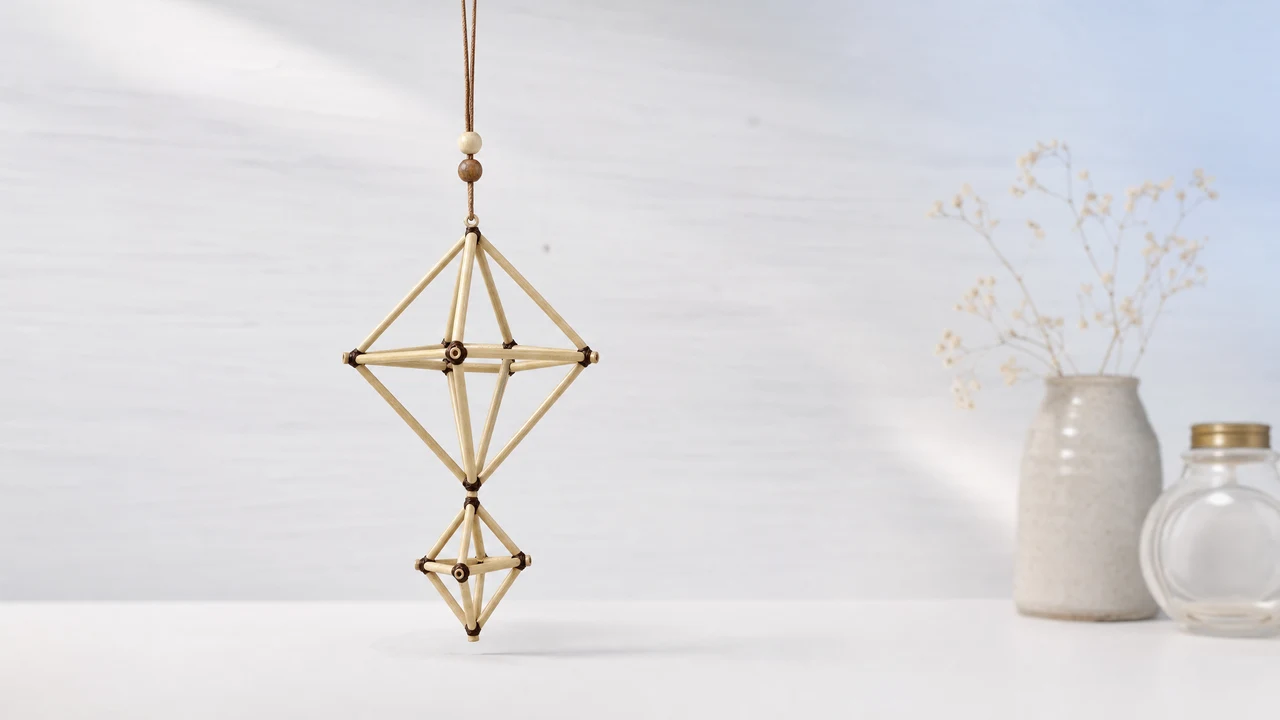
The Finnish himmeli tradition is a straw mobile, built from rye straw into geometric shapes and hung to invite a good harvest and a good year. It belongs to harvest time and midwinter, when the light is low and people hope the coming season will be kind.
Most decor guides treat the himmeli as a pretty geometric ornament. The older meaning is about abundance and the turning of the year, which is worth keeping in view.
What is a himmeli?
A himmeli is a hanging mobile made from lengths of straw threaded together into open, geometric shapes, usually built around octahedrons. It turns slowly in the air, catching light and shadow.
Traditionally it was made from rye straw after the harvest, using stalks from the year's crop. That connection to the grain is the root of its meaning.
The name is thought to come from the Swedish himmel, meaning "sky" or "heaven," which suits an object hung high and left to turn. The himmeli meaning piece covers the straw mobile as a charm in more detail.
Himmeli is shared across the Nordic and Baltic region, not Finland alone, with related straw traditions in Sweden and beyond. Finland is where it is best known today.
Why is the himmeli tied to harvest and light?
The himmeli sits at the meeting point of two things Finns watched closely: the harvest and the light. Both matter enormously in a northern country with long, dark winters.
Made from the new harvest's straw and hung at Christmas or midwinter, it stood as a hope that the next year's crop would be good. It was often kept hanging until the following harvest.
There is a common folk belief that the bigger the himmeli, the better the coming harvest would be. Size was a wish, made visible over the table.
The himmeli is a harvest hope, not a shield. Where the evil-eye charms guard against envy, the himmeli simply asks for abundance in the year ahead.
How the himmeli differs from protection charms
Most of the world's famous charms are defensive: they turn back envy or bad luck. The himmeli is quietly different, and the contrast is the interesting part.
The evil-eye family
- Job: protection, turning back an envious gaze.
- Examples: the Turkish nazar, the Italian cornicello.
- Feeling: guarded, watchful.
The himmeli
- Job: inviting abundance and a good year.
- Placement: hung over the table, in a window, high in a room.
- Feeling: hopeful, celebratory, tied to the season.
The lucky charm meanings around the world guide sorts charms into these two jobs, and the himmeli is a clear example of the "bless a beginning" kind rather than the "guard against harm" kind.
Where do you hang a himmeli?
The classic spot is over the dining table, where it turns above the people gathered beneath it. In many homes it was the centerpiece of the Christmas table.
It is also hung in windows and high in a room, anywhere it can catch light and move gently in the air. The slow turning is part of the appeal.
Because it is made of straw, a traditional himmeli is light and delicate, meant to be admired rather than handled. Modern versions in brass or paper straws last longer and keep the same open geometry.
If you make or buy a himmeli, hang it where air moves a little and light can reach it. A himmeli that turns slowly in a window does exactly what the tradition intends.
A craft as much as a charm
Part of what keeps the himmeli alive is that it is genuinely satisfying to make. Threading straw into balanced octahedrons is a winter craft passed down in families.
That making is part of the meaning. Building a himmeli from the harvest's own straw was a way of marking the year's work and turning it into a hope for the next one.
Even now, far from any rye field, people build them from paper or metal straws for the same reason people everywhere keep charms. It marks a season, a hope, a fresh start, the same instinct behind the customs in irish good luck symbols and chinese good luck symbols.
How is a himmeli made?
The build is simple in principle and satisfying in practice, which is a big reason the craft has lasted. It comes down to straw, thread and patience.
Lengths of straw are cut and threaded onto a strong thread, then joined into a three-dimensional shape, most often an octahedron with eight triangular faces. Smaller units are hung inside or below larger ones to make a tiered mobile.
Traditionally the straw came from the year's rye harvest, softened so it would not crack. That link to the crop is what tied the object to the wish for a good year.
- Rye straw was the classic material, straight from the harvest.
- A balanced octahedron is the core shape, repeated at different sizes.
- A single hanging point lets the whole mobile turn freely in the air.
Modern makers often use brass tubes or paper straws, which last far longer than delicate rye. The geometry stays the same, so a brass himmeli reads instantly as the traditional form.
Real straw himmeli are fragile and were never meant to be handled much. If you want one to keep for years, a metal or paper version holds up better while honoring the same shape.
Does the himmeli connect to other winter customs?
It sits inside a broader northern habit of bringing light and greenery indoors as the darkest days close in. That instinct is shared far beyond Finland.
Hanging something bright over the table at midwinter, whether straw, candles or evergreen, is a way of marking the turn toward longer days. The himmeli is Finland's distinctive contribution to that shared urge.
It also rhymes with harvest customs elsewhere that turn the last of the crop into a token of hope for the next one. The impulse to save a little of this year's grain for next year's luck is old and widespread.
Keeping the idea where you work
A himmeli is made for a room: over a table, in a window, high in the air. Many of us now spend the day at a Mac rather than under the eaves of a farmhouse.
A charm on your screen can carry the same hopeful intent as a mobile over the table. It marks the space you work in and keeps a small seasonal wish where your attention actually lives.
That is the plain idea behind Book My Luck, a small Mac app that hangs a chosen charm, a himmeli among them, from the top of your screen on a thin cord. It sways with real rope physics and reacts to your cursor, which suits an object that was always meant to turn in the air.
It does not claim to bring a good harvest. If you have a real straw himmeli over your table, keep it; the screen charm is for the hours your gaze is on the Mac. You can see what a one-time key costs on the pricing page.
The respectful takeaway
The himmeli is a living Nordic folk tradition, tied to harvest, midwinter and the craft of the season. It belongs to real families who make and hang it with real feeling.
A charm is a charm, not a promise. A himmeli will not fill a granary, but it marks a hope for the year and the turning of the light, which is the job it has always done.
Hung with that understanding, a slowly turning straw mobile is less about superstition and more about welcoming what comes next. And a hope, made and hung on purpose, is worth keeping in view.
FAQ
What is a himmeli?
A himmeli is a Finnish straw mobile, built from lengths of rye straw into open geometric shapes, usually octahedrons, and hung to turn in the air. It is tied to harvest and midwinter and stands as a hope for a good year ahead.
What does the himmeli symbolize?
It symbolizes abundance and a good harvest to come. Made from the year's straw and hung at Christmas or midwinter, it is a hopeful, celebratory charm rather than a protective one.
Where does the word himmeli come from?
It is generally traced to the Swedish word himmel, meaning "sky" or "heaven," which fits an ornament hung high in a room and left to turn slowly in the air.
Where should you hang a himmeli?
Traditionally over the dining table, where it turns above the people gathered beneath it, and also in windows or high in a room. Hang it where the air moves a little and light can reach it.
Is the himmeli only Finnish?
It is best known in Finland but belongs to a wider Nordic and Baltic straw tradition, with related customs in Sweden and neighboring countries. Finland is where the himmeli is most strongly associated today.
Does a himmeli actually bring good luck?
It works as a seasonal hope and a marker, not a guarantee. Making and hanging one celebrates the harvest and wishes for a good year, but it does not control real outcomes; it is a charm, not a promise.
Hang one for the moment that matters
Book My Luck hangs a rendered charm from your Mac or Windows screen, with rope physics and manual interaction. Check the current platform release and regional price before buying.
Get Book My Luck →