Book My Luck
Italian Good Luck Charms: Cornicello and More
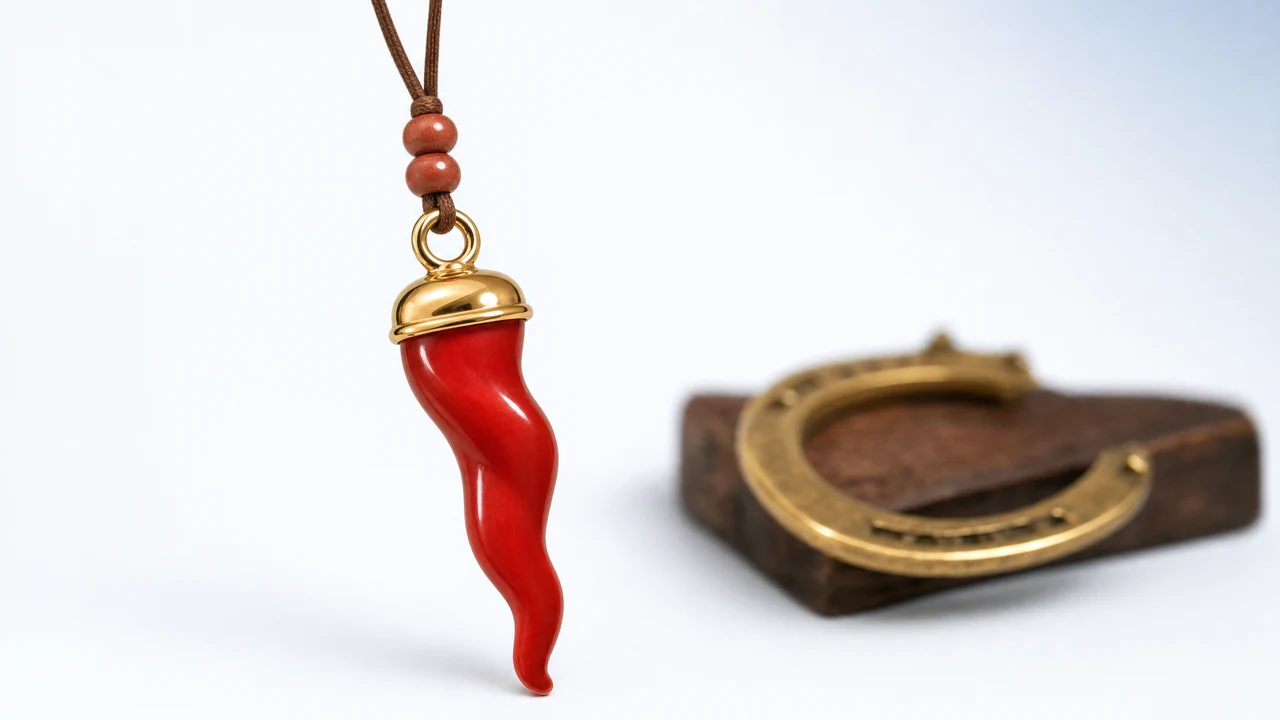
Italian good luck charms center on the cornicello, the slender red horn worn or hung to fend off the malocchio, the evil eye. Alongside it you will find the horseshoe over a door and the little hunchback figure known as the gobbo.
Guides tend to treat the horn as quirky jewelry. It makes far more sense once you know the fear it answers, which is envy.
What are the main Italian good luck charms?
A few charms come up again and again in Italian, and especially Neapolitan, custom. Each has a clear role.
The main Italian good luck charms are the cornicello, the horseshoe and the gobbo, and most of them exist to guard against the malocchio. That evil-eye belief is the thread running through Italian luck culture.
Here is the short version of each.
- Cornicello: a twisted red horn, worn on a chain or hung by a door, against the evil eye.
- Ferro di cavallo: the horseshoe, hung for protection and good fortune.
- Il gobbo: a small hunchback figure, often holding a horn and a horseshoe, considered lucky.
- Mano cornuta: the "horned hand" gesture, index and little finger out, made to ward off bad luck.
Much of this is strongest in Naples and the south, where the cornicello is close to a regional icon. Italy is regional, so customs vary from town to town.
What is the cornicello and why is it red?
The cornicello, sometimes called the cornetto or simply the Italian horn, is a long, twisted horn shape, traditionally red. It is one of the most recognizable charms in the Mediterranean.
Its shape recalls an animal horn, a symbol of strength and protection reaching back to antiquity. The twist and the point are meant to catch and turn away the harmful gaze.
The red is the loaded part. Red coral was long believed to be protective around the Mediterranean, which is why the finest cornicelli are carved from it.
The cornicello meaning piece goes deeper on the horn's shape, its coral tradition, and the rules people attach to giving one.
A common belief is that a cornicello works best when it is given to you, not bought for yourself. A gifted horn is said to carry more protection.
What is the malocchio?
The malocchio, literally "bad eye," is the Italian name for the evil eye. It is the belief that envy or an admiring glance can bring misfortune, headaches or bad luck to the person it lands on.
This is the same core idea as the Turkish nazar and the Indian drishti, dressed in Italian custom. The turkish evil eye piece covers the Mediterranean cousin in detail.
In some families there is even a small ritual to diagnose and lift the malocchio, often involving oil dropped into water and words passed down, usually on a specific night of the year. Practices differ widely by family and region.
If someone gifts you a cornicello, the traditional move is to accept it graciously and wear or hang it. Refusing a protective gift is considered poor form in the custom.
A quick guide to Italian luck charms
Here is how the main charms compare, including where each usually goes.
| Charm | Form | Commonly held meaning |
|---|---|---|
| Cornicello | Twisted red horn | Guards against the malocchio, the evil eye |
| Ferro di cavallo | Horseshoe | Protection and good fortune at the door |
| Il gobbo | Little hunchback figure | General good luck, often holding a horn |
| Mano cornuta | Hand gesture | Warding off bad luck in the moment |
The horseshoe raises its own famous debate about which way it should point, which the horseshoe points up or down piece settles with the common Italian and European view.
Are Italian charms superstition or heritage?
For many Italians the honest answer is both, and often affectionately so. A grandmother's cornicello can be a real belief, a family heirloom, and a running joke all at once.
What they share is a job that outlives the belief. Each one gives a person something to do about a worry they cannot otherwise control.
Before a big day, an exam, a move, an opening, you cannot force the outcome. You can touch the horn, hang the horseshoe, or wear the coral, and the small act carries the nerves.
That is the same reason charms recur across cultures. The lucky charm meanings around the world guide shows the Italian horn sitting comfortably beside the Turkish eye and the Irish clover.
Keeping the horn where you work
The cornicello was made to be worn or hung: on a chain, by a door, on a keyring. Many of us now spend the day at a Mac rather than passing a doorway.
A horn on your screen can carry the same intent as one on a chain. It marks the space you work in and keeps the charm where your attention actually lives.
That is the plain idea behind Book My Luck, a small Mac app that hangs a chosen charm, a cornicello among them, from the top of your screen on a thin cord. It sways with real rope physics and reacts to your cursor, so it feels like an object rather than a picture.
It does not claim to protect anything. If a family cornicello hangs by your door, keep it there; the screen charm is for the hours your gaze is on the Mac. You can see what a one-time key costs on the pricing page.
Are Italian charms the same across the country?
Not really, and the differences are worth knowing. Italy was a patchwork of regions for a long time, and its luck customs still carry that patchwork character.
The cornicello is strongest in Naples and the south, where it is close to a regional emblem. You will see it everywhere from market stalls to rear-view mirrors there, more than in the north.
Some customs are broadly national, like the horseshoe over a door or the mano cornuta gesture. Others are local, tied to a city's own saints, feasts and sayings.
- Naples and the south give the cornicello its deepest roots and its coral tradition.
- Northern regions may lean more on the horseshoe and general European custom.
- Local feasts and saints add customs that do not travel much beyond their town.
Try not to flatten "Italian luck" into one thing. The cornicello is iconic, but describing it as the Italian charm everywhere overlooks how regional these customs really are.
The safest way to speak about it is to name the region when you can. A charm that defines a Neapolitan market may barely appear a few hundred kilometers north.
The respectful takeaway
Italian luck charms are living heritage, not costume. The cornicello in particular is bound up with family, region and coral craft, and it deserves an accurate telling.
A charm is a charm, not a promise. The horn will not change an outcome, but it marks what you value and steadies you, which is the job it has always done around the Mediterranean.
Worn or hung with that understanding, a small red horn is less about superstition and more about care, passed from one hand to another. And care, given on purpose before a hard thing, is worth keeping close.
FAQ
What is the Italian cornicello?
The cornicello is a twisted red horn worn on a chain or hung by a door to guard against the malocchio, the evil eye. Its horn shape signals protection, and the finest are carved from red coral, long held to be protective in the Mediterranean.
Why is the Italian horn red?
Red coral was traditionally believed to be protective around the Mediterranean, so classic cornicelli are made from it. The red color and the horn's pointed, twisted shape together are meant to turn away the harmful gaze.
What is the malocchio?
The malocchio, or "bad eye," is the Italian evil eye: the belief that envy or an admiring glance can bring bad luck or headaches. It is the same core idea as the Turkish nazar and the Indian drishti, and most Italian charms exist to counter it.
Should a cornicello be given as a gift?
Tradition holds that a cornicello works best when it is given rather than bought for yourself, so a gifted horn is thought to carry more protection. It is also considered poor form to refuse one offered to you.
Is the horseshoe an Italian good luck charm too?
Yes, the ferro di cavallo is hung for protection and fortune in Italy as in much of Europe. There is the usual debate about which way it should point, with the common view being points up so the luck does not run out.
Do Italian good luck charms actually work?
They work as rituals and markers, not guarantees. A cornicello or horseshoe steadies you and names what you value, like a lucky pen or a family habit, but it does not control real outcomes; it is a charm, not a promise.
Hang one for the moment that matters
Book My Luck hangs a rendered charm from your Mac or Windows screen, with rope physics and manual interaction. Check the current platform release and regional price before buying.
Get Book My Luck →