Book My Luck
Horseshoe Luck: Points Up or Points Down?
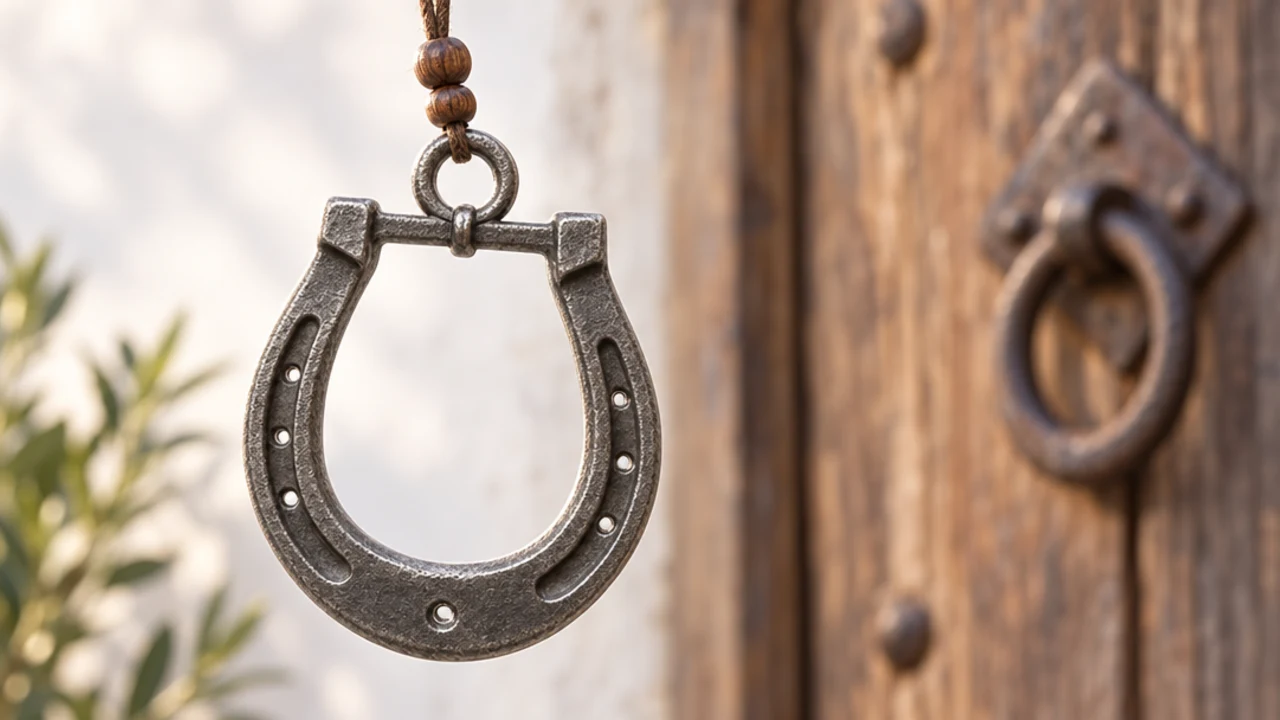
Horseshoe points up or down are both traditional, and neither is wrong: points up holds luck in like a cup, while points down pours protection over anyone who passes beneath. Which you choose depends on whether you want to gather luck or spread it.
Most arguments about this pretend there is one true way. The honest answer is that it splits by region and family custom, and both readings are old and sincere.
Horseshoe points up or down: what is the difference?
The two ways carry two ideas. It comes down to whether the shoe is a container or a spout.
Points up (like a U)
- Reading: the shoe cradles luck so it cannot spill out.
- Feel: a cup that fills over time.
- Common in: much of Britain, Ireland, and North America.
Points down (like an arch)
- Reading: luck and protection pour down over the doorway.
- Feel: a blessing raining on everyone who enters.
- Common in: parts of Europe and many Catholic households.
So the horseshoe points up or down question is really about intention. Points up gathers luck; points down showers it on all who pass under.
Pick the one that fits your door and your family. If your grandmother hung it one way, that memory is a perfectly good reason to keep it.
Points up holds luck in like a cup. Points down pours it out over the threshold. Both are traditional, so choose the story you like.
Why is a horseshoe lucky at all?
Several old ideas stack together. The shoe is made of iron, long believed to ward off harm, and it was forged in fire by a blacksmith, a respected and slightly magical trade.
It also has a curved, protective shape and, in some tellings, seven nail holes, seven being a lucky number. Add the horse, a valued and hard-working animal, and the shoe carried good associations before anyone hung it on a door.
There is a well-known legend about a blacksmith and the devil that ties the horseshoe to protection at the threshold. It is folklore rather than history, so it is best enjoyed as a story rather than cited as fact.
For a front door, points down is the classic "protect everyone who enters" choice. For a personal space like a desk or study, points up to gather your own luck feels right.
Where should you hang a horseshoe?
Thresholds are the traditional spot. A front door, a barn, a workshop, above a bed, or over the entrance to a new home.
The logic is protection at the crossing point, where luck and harm are thought to enter. That is why a horseshoe so often appears right above or beside a door.
A found horseshoe is considered especially lucky, more so than a bought one, because the finding itself feels like fortune. Either way, iron and the horse's work give it weight.
For other threshold charms and how they compare, the lucky charm meanings around the world guide places the horseshoe next to the clover, the nazar, and more.
Does a horseshoe actually bring luck?
Here is the plain answer. It is a charm, not a promise, and it will not change a test, a deal, or a race.
Its real value is in the marking. A horseshoe turns a doorway into a threshold you notice, a small line between out there and in here, which is a steadying thing to have.
Hanging one is also an act of care, often for a home or a family. That intention is genuine, even though the iron does nothing to the odds.
The tradition sits mostly in European and American folklore, and it deserves plain description rather than mockery. Where exact origins are murky, it is fairer to say the belief is old and widely held than to invent a date.
It is a charm, not a promise. Never treat a horseshoe as a guarantee of any outcome. Its worth is in meaning and the marking of a threshold.
The horseshoe on your screen
The iron shoe has moved from barn doors to desktops. A lucky charm app for Mac can hang a horseshoe from the top of your screen, on a cord with real rope physics, so it sways and reacts to your cursor.
You can see how that works and what it costs on the pricing page. It is one tasteful object rather than another notification.
If you like the clover just as much, the four-leaf clover meaning guide pairs well with this one, since both are staples of European good-luck lore.
How do you hang a horseshoe at home?
Start with the direction you have chosen and commit to it. Points up if you want to gather luck, points down if you want to pour protection over the doorway, and then fix it firmly so it does not slip.
Height and visibility matter. A horseshoe above or beside a door, at a level people can see, does its threshold job better than one hidden low or tucked away.
Many people use the actual nail holes to hang it, which nods to the old idea of the lucky nails. A found shoe is prized, but a gifted or bought one works the same in the tradition.
There is no rule against cleaning off the rust or leaving it weathered. Some like the honest, used look of an old shoe, while others polish it, and both are fine since the meaning is in the placing, not the finish.
Fix the horseshoe securely with more than one nail or screw. A shoe that falls is simply an annoyance, not an omen, so mount it so it stays put.
Does a found horseshoe mean more?
In folklore, yes, and the reason is charming. A shoe you stumble upon feels like luck arriving on its own, so finding one is treated as more fortunate than buying one.
That reading fits the wider theme of luck as something noticed rather than purchased. It is the same instinct behind prizing a four-leaf clover you spot in the grass.
Either way, once it is yours, the tradition treats it the same. You choose the direction, hang it at the threshold, and let it mark the crossing point.
A quick word on iron and protection
Iron shows up again and again in protective folklore, not only in horseshoes. Nails, blades, and gates all carried the same reputation for keeping harm out.
That is part of why the horseshoe stuck. It combined a protective metal, a fire-forged making, a lucky shape, and a hard-working animal, all in one object you could hang by the door. Compare it with the watchful blue evil eye meaning and you see two different cultures reaching for the same instinct: guard the threshold.
The blacksmith connection ran deep in older communities. A smith worked fire and iron in a way that looked almost magical, so objects from the forge carried some of that reputation for keeping harm away.
None of this needs to be literally true to be meaningful. The horseshoe endures because it gathers several comforting ideas into one sturdy object you can nail above a door and glance at on your way out.
That durability is part of the appeal. Unlike a fragile bead or a paper charm, an iron shoe feels built to last, which suits a symbol meant to guard a home for years.
It also ages well. A weathered horseshoe carries a sense of history, so an old one over a door reads as a charm that has already been keeping watch for a long time.
Should a horseshoe point up or down for luck?
Both are traditional. Points up holds luck in like a cup, while points down pours protection over everyone who passes beneath, so choose the reading you prefer.
Why is a horseshoe considered lucky?
It combines iron, long thought to ward off harm, a fire-forging by a respected blacksmith, a protective curved shape, and its link to the valued horse. Those ideas stacked into a single lucky object.
Is it unlucky to hang a horseshoe upside down?
No. Points down is a genuine tradition in parts of Europe and many Catholic homes, read as luck pouring out over the doorway rather than luck being lost.
Where is the best place to hang a horseshoe?
Over or beside a threshold, such as a front door, a barn, a workshop, or the entrance to a new home. Thresholds are where luck and harm are believed to cross.
Does a found horseshoe bring more luck than a bought one?
In folklore, yes. Finding a horseshoe is considered especially fortunate, since the finding itself feels like a stroke of luck.
Does a horseshoe actually bring good luck?
It is a charm, not a promise. It marks a threshold and steadies you, and it never claims to change a real outcome you cannot control.
Book My Luck today
Book My Luck is a desktop decoration for macOS 14+ and Windows 10/11. The desktop outside the charm remains clickable. The current Mac and Windows downloads are version 1.0.32, signed by KAK DIGITAL LLC. On Mac, Charm Centre controls size, cord length, placement, displays and motion. Collections and controls can differ between Mac and Windows.
There is no calendar integration, booked-moment scheduler or native-app free trial. Explore the website demo and regional pricing. One key activates one computer at a time; activation and license refresh require internet. Preferences are local, but purchasing, activation and website analytics use online services described in the privacy policy.
Hang one for the moment that matters
Book My Luck hangs a rendered charm from your Mac or Windows screen, with rope physics and manual interaction. Check the current platform release and regional price before buying.
Get Book My Luck →