Book My Luck
Cornicello Meaning: The Italian Horn vs Malocchio
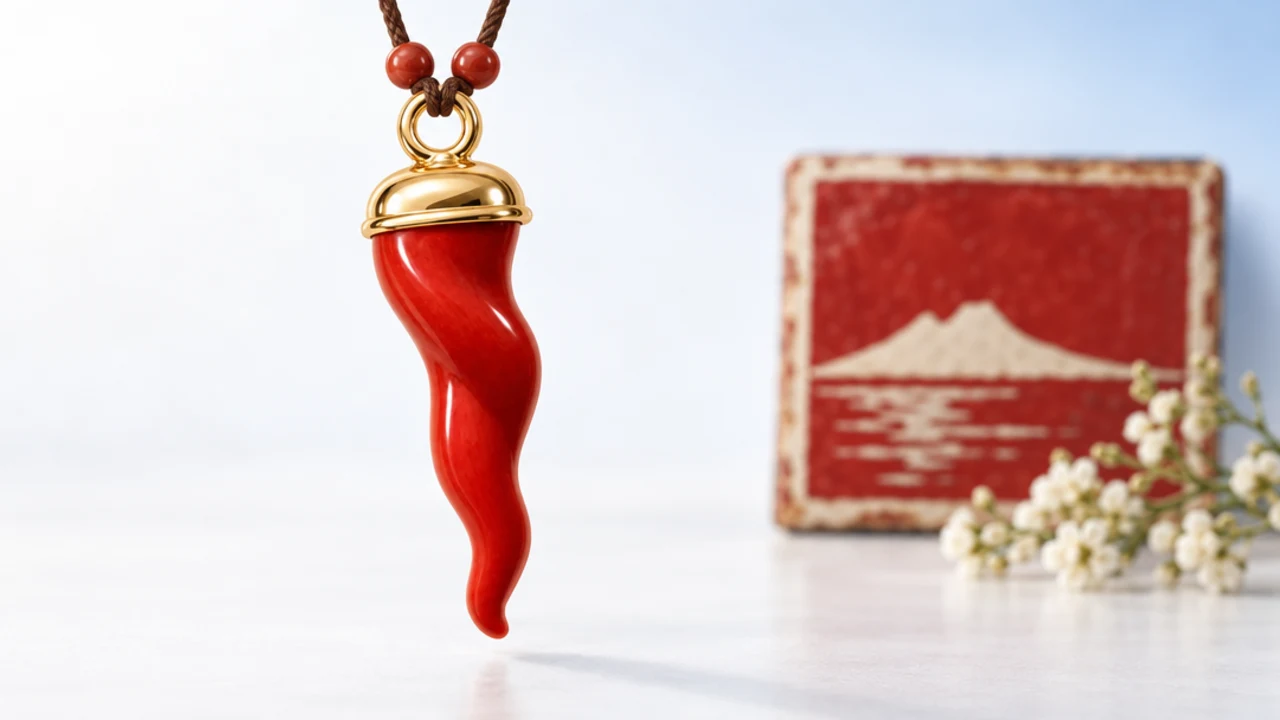
The cornicello meaning is protection: it is a small twisted horn worn in Italy to turn away the malocchio, the evil eye of envy. The cornicello meaning also carries an older wish for strength and life, which is why the shape is a horn rather than a coin or a cross.
Most explanations stop at "Italian good luck horn." The real story runs through Naples, through red coral, and through a quiet rule about who is allowed to buy one.
What is a cornicello?
A cornicello is a slender, curved horn, usually about the length of a finger and often twisted like a chili or a single ram's horn. The name means "little horn," and you will also hear it called a corno or a corno portafortuna, the lucky horn.
It hangs from a chain, a keyring or a rear-view mirror, and it is worn openly. A twisted horn shape is the giveaway; once you know it, you spot cornicelli all over southern Italy.
The classic version is a deep, glossy red. That colour is not decoration alone, and it points back to the material the charm was first made from.
Why is the cornicello red?
Traditionally the cornicello is carved from red coral, and coral itself was long thought to protect. Sailors and mothers across the Mediterranean used coral against harm, so a coral horn stacked two old defences into one object.
When coral is not used, the horn is made in gold or silver, or in red glass or plastic for everyday wear. Red coral remains the prestige version, the one handed down in families.
The red also echoes blood and life, which fits the horn's older meaning. A horn stood for animal strength and fertility long before it stood for luck at the lottery.
The cornicello's deepest roots are debated, and honest sources say "likely" rather than "certainly." It is commonly traced to ancient horn amulets tied to a lunar or animal cult of strength, but no single founding date is agreed, so treat any exact year you read with caution.
What is the malocchio, and how does the horn work against it?
The malocchio is the Italian evil eye: the idea that envy, especially an admiring or jealous glance, can bring bad luck to the person it lands on. It is the same fear you find right around the Mediterranean under different names.
The cornicello is the counter-charm. The belief is that the horn catches or deflects that envious look before it can settle on you.
If you want the wider version of this idea, the evil eye meaning guide covers how many cultures share the same worry and answer it in their own way. The cornicello is simply Italy's answer, shaped like a horn instead of a blue glass bead.
Envy, not fate is what the malocchio is about. The horn is there for the moment someone praises your new car a little too warmly.
The gift rule that surprises people
Here is the custom that trips up newcomers. A cornicello is widely believed to work best when it is given to you, not bought by you.
The idea is that the charm carries the goodwill of the person who chose it. A horn you buy for yourself is thought to lose some of that force.
If you want a cornicello, the gracious move is to mention it to someone who might gift it, or to buy one for a friend rather than yourself. Whether or not you take the superstition seriously, the gesture turns a trinket into something with a story attached.
This is not a hard law, and plenty of Italians buy their own. But the gift tradition is part of why the charm feels personal in a way a keyring rarely does.
Cornicello, mano cornuta and the horseshoe
The horn shape shows up in Italy in more than one form, and it helps to keep them straight. Here is a quick side-by-side of three lucky "horns."
Cornicello
- What it is: a worn charm, a small twisted horn on a chain
- Job: wards off the malocchio, carries a wish for strength
- Best known in: Naples and southern Italy
Mano cornuta
- What it is: a hand gesture, index and little finger extended like horns
- Job: the live, on-the-spot version of the same protection
- Note: context matters, since the same shape can be rude in other settings
Horseshoe
- What it is: an iron shoe hung over a door, points up
- Job: general luck and protection for a household
- Best known in: Europe and the Americas more broadly
The cornicello and the mano cornuta are close cousins, one an object and one a gesture. The horseshoe is a different tradition that happens to share the same instinct, and you can read more on where each fits in Italian good luck charms.
How do you wear or keep a cornicello?
The cornicello is meant to be visible, not hidden. It is worn on a chain at the throat, clipped to keys, or hung from a car's rear-view mirror where the driver can see it.
The point of that visibility is a little counter-intuitive. The charm is not shy about being seen, because being seen is part of how it draws and deflects the envious glance away from you.
Worn openly is the tradition, so a cornicello tucked away in a drawer is doing less than one out in the light. It is a working object, not an heirloom to be stored.
Colour and material give you room to choose. The red-coral version is the classic and most prized, gold and silver read as fine gifts, and everyday plastic or glass horns are common and perfectly acceptable for daily wear.
Real red coral is a natural material under pressure from over-harvesting in some regions. If that matters to you, a glass, ceramic or metal cornicello carries exactly the same meaning without the concern.
Keeping a cornicello where you actually are
A coral horn is a beautiful thing to wear, but it stays with your keys or your neck. A lot of the moments where you feel watched or judged happen at a screen, in an interview call or a live demo, far from any keychain.
That is the gap a small Mac app can fill. Book My Luck is a menu-bar app that hangs a charm from the top edge of your screen on a thin cord, with real rope physics, and it clicks straight through so it never blocks your work.
The honest line, which Italy would agree with: it is a charm, not a promise. A cornicello marks a moment and steadies you, the way a lucky pen or a small ritual does. It does not control who envies you or how the day turns out.
Where the cornicello sits among the world's charms
The cornicello is one node in a much larger network of protective objects. Nearly every culture that fears the envious glance has built a charm to answer it, from the blue nazar of Turkey to the hamsa of North Africa.
Seen in that light, the Italian horn is not an oddity but a local dialect of a shared language. The lucky charm meanings around the world guide lays out how these traditions rhyme without copying each other.
A local dialect is the right way to think of it. The grammar is protection against envy; the accent is Neapolitan red coral.
What does a cornicello protect against?
The cornicello wards off the malocchio, the Italian evil eye, which is the belief that envious or admiring glances can bring misfortune. It also carries an older meaning of strength and life, drawn from the horn shape itself.
Is it bad luck to buy a cornicello for yourself?
Custom holds that a cornicello works best when it is given as a gift, because it carries the goodwill of the giver. Buying your own is not forbidden and many Italians do it, but the gift tradition is a real and widely respected part of the charm.
Why is the Italian horn red?
The classic cornicello is carved from red coral, which was itself thought to protect against harm across the Mediterranean. The red also echoes blood and life, which fits the horn's association with strength and fertility.
What is the difference between the cornicello and the mano cornuta?
The cornicello is a physical charm, a small twisted horn you wear, while the mano cornuta is a hand gesture that makes the same horn shape with the fingers. Both aim to ward off the evil eye, one as an object and one as an on-the-spot action.
Where is the cornicello most popular?
It is strongly associated with Naples and southern Italy, where you see it on chains, keyrings and rear-view mirrors everywhere. From there the charm has spread through Italian communities around the world.
Does a cornicello actually bring good luck?
No charm can promise an outcome, and an honest answer says so plainly. The cornicello is a charm, not a promise; it steadies you and marks a moment, but it does not control luck or the people around you.
Book My Luck today
Book My Luck is a desktop decoration for macOS 14+ and Windows 10/11. The desktop outside the charm remains clickable. The current Mac and Windows downloads are version 1.0.32, signed by KAK DIGITAL LLC. On Mac, Charm Centre controls size, cord length, placement, displays and motion. Collections and controls can differ between Mac and Windows.
There is no calendar integration, booked-moment scheduler or native-app free trial. Explore the website demo and regional pricing. One key activates one computer at a time; activation and license refresh require internet. Preferences are local, but purchasing, activation and website analytics use online services described in the privacy policy.
Hang one for the moment that matters
Book My Luck hangs a rendered charm from your Mac or Windows screen, with rope physics and manual interaction. Check the current platform release and regional price before buying.
Get Book My Luck →