Book My Luck
Peacock Feather Meaning: Luck, Envy and Good News
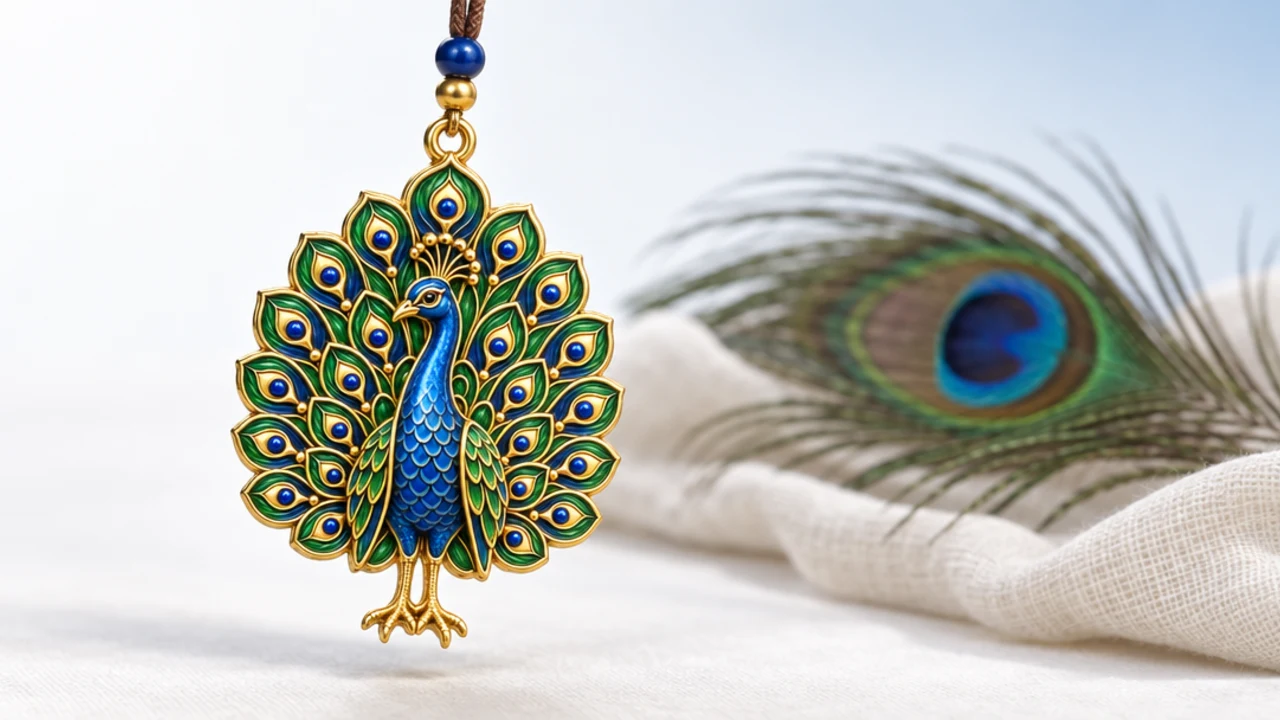
The peacock feather meaning splits neatly in two: across India it is a bright sign of beauty, good news and divine favour, while in parts of Europe the "eye" in the feather was long read as bad luck. So the honest answer is that it depends entirely on where the custom grew up.
Most quick takes pick one side and call it the truth. The feather is more interesting than that, because the same "eye" that blesses in one place is feared in another.
What is the peacock feather meaning in India?
In India the peacock is close to sacred, and its feather carries warmth wherever it appears. It is tied to gods, to seasons and to plain everyday luck.
Krishna is shown with a peacock feather in his crown, which alone makes the feather beloved across much of the country. The god Murugan rides a peacock, so the bird carries courage and youth as well.
Beyond the gods, the feather reads as good news on its way. Finding a peacock feather is widely taken as a small omen that something good is coming.
There is a practical layer too. Feathers are kept between the pages of books and near sacred texts, a custom often said to invite learning and to keep silverfish away, which is a nice mix of luck and housekeeping.
In the Indian reading, the "eye" in the feather is a watchful, protective thing. It looks out for you rather than warning about you.
Why do some people think peacock feathers are unlucky?
In parts of Britain and Europe the same eye earned a darker name. The pattern at the end of the feather was often compared to the evil eye, the envious stare people have feared for centuries.
You still hear the old theatre superstition that peacock feathers on stage bring disaster to a production. It is a folk belief, not a rule, but it shows how strong the association became.
So the peacock feather meaning flips entirely across this border, and the two readings are really the same raw idea seen from opposite ends. One culture keeps the eye close to guard you; another keeps it away so it cannot curse you.
If that watching-eye idea pulls at you, the wider evil eye meaning traces how a single stare became a charm across so many countries.
The theatre superstition is commonly repeated but has no single agreed origin. Treat it as folklore, not fact, and never as a reason to look down on anyone who believes it.
Peacock feather beliefs, side by side
The feather is a good example of how one object collects opposite meanings. Here are three traditions in plain terms.
| Where | What the feather means | Common use |
|---|---|---|
| India | Beauty, good news, divine favour | Kept in books, near shrines, worn |
| Parts of Europe | The envious eye, an omen to avoid | Kept off the stage, out of the home |
| Modern desk culture | Confidence and a bit of colour | A small cue before a big moment |
None of these is the "correct" one. A symbol means what the people who use it have long agreed it means, and that is allowed to differ by place.
How do you use a peacock feather for luck today?
Keep it simple and keep it honest. The feather works the way any small ritual works: it marks a moment and settles you before it.
Set one on your desk before a day you are nervous about, or keep one in the bag you carry to interviews. The point is the glance, the two seconds where you remember you chose to be brave.
Some people fan a feather or run a thumb along it as a tiny reset. If that feels good, it is doing its job.
Match the feather to the moment it stands for. A student might keep one in a revision folder; a speaker might keep one where they rehearse. The place makes the cue mean something.
This is the same logic a screen charm uses. In Book My Luck, the peacock charm hangs from the top of your Mac and its ritual is to fan the feathers, so the cue arrives right when you need it and then settles out of the way.
Is the peacock feather a promise of good news?
No, and it never claimed to be. A charm is not a promise; it works like a lucky pen or a warm-up routine, not like a spell that changes the result.
The good it does is real but modest. It steadies your nerves, gives you a small story to hold, and turns a scary minute into a familiar one.
Think of the difference between walking into a room tense and walking in calm. The feather does not write your luck; it changes the person who meets it.
That is plenty. Treat the outcome as yours to earn and the feather as the friend who walks you to the door.
Because the feather sits in so many traditions at once, it is a good doorway into the bigger picture of lucky charm meanings around the world, where the same theme repeats in country after country.
The feather and the courage it borrows
It helps to remember where the feather gets its confidence. Much of the Indian warmth around it comes from Murugan, the young Tamil god who rides a peacock into anything that asks for nerve.
That link is worth following if the feather appeals to you as a courage cue. The murugan vel meaning explains the lance and the bird together, and it is where the peacock's brave streak really comes from.
For the wider south Indian customs the feather lives inside, tamil good luck customs sets out the doorway rituals, the kolam and the guardian figures it keeps company with.
Why does the peacock itself carry so much meaning?
The feather borrows its power from the bird, and the bird is genuinely striking. A peacock in display is one of nature's boldest sights, and cultures have read that boldness in many ways.
In India the bird is admired for turning the rainy season into something to celebrate, since peacocks call and dance as the monsoon arrives. That link to rain and renewal gives the feather a quiet note of hope and fresh starts.
The bird is also the national bird of India, which has kept it woven into everyday life and art. The feather is not a rare curiosity there; it is part of the visual language of the country.
There is a moral reading too, and it is a nice one. The peacock is often used to show that pride can be beautiful when it is earned and carried well, rather than something to hide.
If you like the feather but worry it reads as showy, lean on this reading. Confidence you have earned is not arrogance, and the feather can stand for exactly that on a day you need to be seen.
How is the feather used in art and the home?
Long before it was a desk charm, the feather was a decorating tradition. It appears in fans, in crowns, in temple art and in the hand-held fans once used by royalty and in ritual.
In homes across India it is common to keep a small bunch of feathers in a vase or tucked behind a picture. The custom is casual and warm, closer to keeping fresh flowers than to performing a spell.
That everydayness is worth copying. A charm you live alongside quietly does more than one you put on a pedestal.
The feather also travels well into a modern workspace because it asks for nothing. It does not need water, winding or winding down; it simply sits there and catches the light.
That low-maintenance quality is part of why it suits a desk. You can keep one for years, glance at it before hard moments, and let it do its small, steadying work without any fuss.
FAQ
Is a peacock feather good luck or bad luck?
It depends on the tradition. In India it is strongly good luck and a sign of good news, while in parts of Europe, especially in theatre, it has been considered unlucky because the "eye" was linked to envy.
Why is the peacock feather linked to Krishna?
Krishna is traditionally shown wearing a peacock feather in his crown, and many stories explain how he came to wear it. That association makes the feather deeply loved and auspicious across much of India.
Can I keep a peacock feather at home?
In Indian custom, yes, and it is common to keep feathers in books, near shrines and around the home for good fortune. If you follow the European theatre tradition you might avoid the stage, but at a desk it is widely seen as fine.
What does finding a peacock feather mean?
It is commonly taken as a gentle omen that good news is coming or that you are on a good path. It is folklore rather than fact, so enjoy it as a nice sign rather than a guarantee.
Does the eye in the feather relate to the evil eye?
Yes, the two ideas are connected. Both centre on an "eye," but Indian custom keeps it close as a protector while some European folklore treated it as the envious stare to keep away.
How do I use a peacock feather before a big moment?
Place it where you will see it, glance at it, and take one calm breath as your cue to begin. It steadies your nerves without pretending to change the outcome, which is exactly what a small ritual should do.
Hang one for the moment that matters
Book My Luck hangs a rendered charm from your Mac or Windows screen, with rope physics and manual interaction. Check the current platform release and regional price before buying.
Get Book My Luck →