Book My Luck
Chinese Knot Meaning: The Endless Knot for Good Fortune
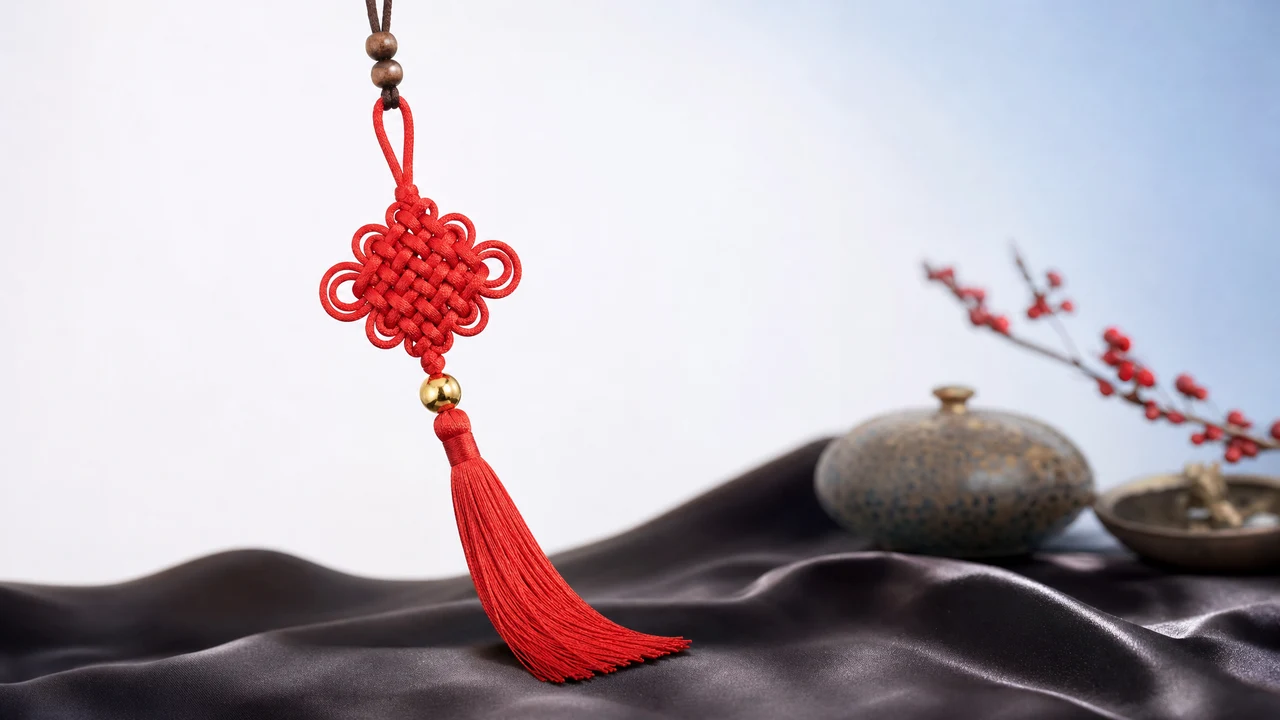
The Chinese knot meaning is long life, connection, and good fortune, all tied from a single unbroken cord that has no clear beginning or end. The most famous form is the endless knot, called pánchāng jié, whose looping shape stands for continuity.
Most people see the red cord as pure decoration. It is decorative, but the technique and the shape carry meanings that are worth knowing before you hang one.
What is the Chinese knot meaning?
Chinese knotting is a folk craft where a single length of cord is tied into a symmetrical design, usually in red, with two cords running through each loop. The result looks the same front and back, which is part of its appeal.
The Chinese knot meaning grows from how it is made. Because the endless knot is one continuous cord with no visible start or finish, it reads as long life, unbroken connection, and fortune that keeps circling back.
Red deepens the reading. In Chinese custom red is the color of luck and joy, which is why these knots appear at New Year, weddings, and celebrations.
One unbroken cord, no start and no end. The endless knot reads as continuity, so the Chinese knot meaning is long life, connection, and steady good fortune.
Why does the endless knot have no beginning or end?
The pánchāng jié is tied so the cord loops back into itself, hiding where it started. That closed loop is the whole idea.
A line with no ends cannot run out, so it stands for continuity and long life. In many readings it also suggests that good things and relationships keep coming around rather than stopping.
The endless knot is also one of the auspicious symbols in Buddhist tradition, where it carries related meanings of interconnection. That shared use is part of why the shape feels so weighty.
Give an endless knot to mark something you want to last, like a friendship, a marriage, or a new chapter. The unbroken cord is the message.
Where do people hang Chinese knots?
They appear at thresholds and on gifts. A front door, a rearview mirror, a wall, a fan, or dangling from a bag or an instrument.
The timing matters as much as the place. Knots come out for Lunar New Year and weddings, when a wish for lasting luck and joy fits the occasion.
They also travel as gifts between people who want to mark a bond. The knot's symmetry and unbroken cord make it a quiet way to say "may this continue."
For where the knot sits among charms from Turkey, Japan, Italy, and India, the lucky charm meanings around the world guide lines them up with care.
Chinese knot or evil eye: what kind of luck?
Both are hung for good fortune, so people compare them. They pull in different directions.
Chinese endless knot
- Wish: long life, connection, continuity.
- Feel: warm, celebratory, binding.
- Best for: marking a lasting bond or a new year.
Evil eye (nazar)
- Wish: protection from an envious gaze.
- Feel: watchful, guarding.
- Best for: shielding something new or prized.
The knot invites good things to continue, while the eye keeps harm away. If protection is your worry, the evil eye meaning guide covers the blue nazar in detail.
Does a Chinese knot really bring fortune?
Here is the honest answer. It is a charm, not a promise, and a tied cord will not extend a life or fix a relationship on its own.
Its value is human and real. A Chinese knot marks a wish for continuity, and giving or hanging one is a small, sincere act of care at a moment that matters.
The craft itself is part of the gift. Hand-tying a knot takes patience and skill, so the object carries the maker's time and intention.
The tradition is Chinese folk craft with deep roots, and the endless knot also appears in Buddhist symbolism. Precise origins for the craft are hard to date, so it is fairer to say knotting is an old and living art than to fix it to a single time.
It is a charm, not a promise. Never treat a Chinese knot as a guarantee of any outcome. Its worth is in the meaning and the care it marks.
The knot on your screen
The red cord has a natural home on the desktop. A lucky charm app for Mac can hang a Chinese endless knot from the top of your screen, on a cord with real rope physics, so it sways and reacts to your cursor.
The ritual carries over. With Book My Luck you cinch the cord, a small tightening gesture, and the knot settles back over your work.
You can see how that works and what it costs on the pricing page. It is one tasteful object rather than another notification.
How is a Chinese knot tied?
The craft is deceptively simple to describe and hard to master. A single cord is folded and looped in a set sequence, then pulled tight so the pattern locks into a flat, symmetrical shape.
Two cords typically run through each loop, and the design reads the same on both faces. That double-corded, reversible quality is a hallmark of the craft and part of why a good knot looks so clean.
Traditional knots are tied by hand, and a complex one takes patience and a steady sequence of moves. The tightening at the end is what sets the shape, which is why the on-screen ritual in Book My Luck is a small cinch of the cord.
Beginners often start with a basic square or button knot before moving to the endless knot. Learning the order of loops is the real skill, since a single wrong pass unravels the symmetry.
If you want to try knotting, start with a short, stiff cord and a simple pattern. The endless knot is easier once your hands know the basic loops.
Do the colors and tassels mean anything?
Red is the classic choice for luck and joy, but knots come in many colors. Gold often signals wealth, while other shades suit calmer or more personal wishes.
Tassels and beads are frequently added below the knot. They lengthen the piece for hanging and can carry their own small meanings, such as coins for prosperity.
As with most folk charms, treat these color readings as popular associations rather than a fixed code. The heart of the meaning stays in the unbroken cord and the care of the tying.
A note on knot types
The pánchāng jié, or mystic knot, is the best known, but Chinese knotting includes many named forms. There are knots shaped like coins, buttons, and flowers, each with its own look and use.
The common thread is a single cord tied with care into a balanced shape. That craft, more than any single pattern, is what makes Chinese knots meaningful.
The art has stayed alive because it is both decorative and giftable. A knot can dress a room, finish a gift, or hang from a bag, so it keeps finding new places to be useful.
That practicality is part of why it travels well onto a screen. A shape built to hang and sway sits naturally at the top edge of a display, where it can mark a moment without getting in the way.
Whatever form you choose, the meaning holds. One unbroken cord, tied with patience, standing for a wish that you want to last.
What does the Chinese knot symbolize?
It symbolizes long life, connection, and good fortune, tied from a single unbroken cord. The endless knot in particular stands for continuity, since it has no visible beginning or end.
What is the endless knot called in Chinese?
It is called pánchāng jié, sometimes translated as the mystic or endless knot. It is tied so the cord loops back into itself with no start or finish.
Why are Chinese knots red?
Red is the color of luck and joy in Chinese custom, which is why knots for New Year, weddings, and celebrations are usually red. The color deepens the knot's wish for good fortune.
When do people give Chinese knots?
They are common at Lunar New Year and weddings, and as gifts to mark a lasting bond. The unbroken cord makes them a fitting way to wish that something continues.
Is the endless knot Buddhist?
The endless knot appears among the auspicious symbols in Buddhist tradition, carrying meanings of interconnection, and it is also a staple of secular Chinese folk craft. It bridges both.
Does a Chinese knot actually bring good luck?
It is a charm, not a promise. It marks a wish for continuity and carries the maker's care, and it never claims to change a real outcome you cannot control.
Book My Luck today
Book My Luck is a desktop decoration for macOS 14+ and Windows 10/11. The desktop outside the charm remains clickable. The current Mac and Windows downloads are version 1.0.32, signed by KAK DIGITAL LLC. On Mac, Charm Centre controls size, cord length, placement, displays and motion. Collections and controls can differ between Mac and Windows.
There is no calendar integration, booked-moment scheduler or native-app free trial. Explore the website demo and regional pricing. One key activates one computer at a time; activation and license refresh require internet. Preferences are local, but purchasing, activation and website analytics use online services described in the privacy policy.
Hang one for the moment that matters
Book My Luck hangs a rendered charm from your Mac or Windows screen, with rope physics and manual interaction. Check the current platform release and regional price before buying.
Get Book My Luck →