Book My Luck
Murugan Vel and Peacock: Courage Before a Climb
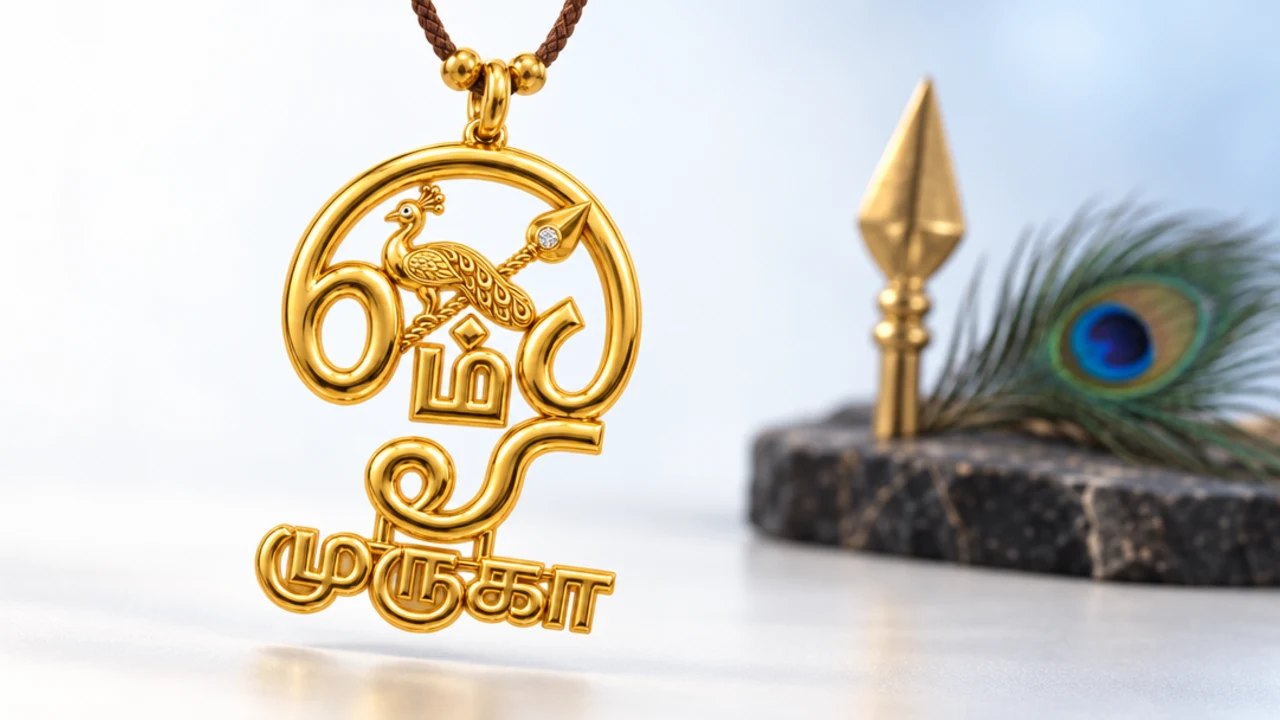
The Murugan vel meaning is courage sharpened to a point: the vel is the lance the Tamil god Murugan carries, and it stands for a clear mind that cuts straight through fear. People keep it near before anything that asks for nerve, from an exam hall to a first day on a new site.
Most explanations stop at "it is a weapon," which misses the whole idea. In Tamil devotion the vel is less about fighting and more about seeing clearly under pressure.
What is the Murugan vel meaning?
Murugan is one of the most loved gods in Tamil Nadu, worshipped across the south and wherever Tamil families have settled. He is also known as Kartikeya, Skanda and Subramanya, and he is the young, warrior son of Shiva and Parvati.
The vel is his spear. In the commonly told story, his mother Parvati gives him the vel so he can defeat a demon that no one else could face.
That gift is the part people hold onto. The vel is a mother's confidence handed to a child who has to go do something hard.
Over time the lance came to mean more than the battle. It is read as gnana, sharp knowledge, the kind of focus that finds the one weak point in a problem and aims there.
The vel is not really about violence. It is about a mind so clear that fear has nowhere to hide, which is why students and first-time performers reach for it.
Why is a peacock beside him?
Murugan's mount, his vahana, is a peacock named Paravani. He is almost always shown riding it or standing with it near.
The peacock carries its own set of meanings. It is beauty that is not shy, a bird that opens its whole tail and dares you to look.
There is a gentler reading too. In several tellings the peacock was once a proud creature that Murugan tamed, so the bird stands for pride turned into service rather than pride for its own sake.
Put the two together and you get a full picture. The vel is the nerve, the peacock is the presence — the steadiness to do the thing and the confidence to be seen doing it.
If the bird itself interests you, the peacock feather meaning has a longer, tangled history of luck and envy worth reading on its own.
How do people actually use the vel?
The everyday custom is small and physical. Before a test of nerve, a person touches or lifts the vel, says a short prayer or just a breath of intent, and goes.
The bigger, public version is the kavadi carried at the festival of Thaipusam. Devotees take a vow, then carry an ornate frame — the kavadi — often decorated with peacock feathers, as an act of thanks or petition.
You do not need a festival to borrow the idea. The gesture is the point: a clear signal to yourself that the moment has started and you are ready to meet it.
Pair the vel with one plain sentence you say every time, like "clear head, steady hands." The words plus the movement is what makes it stick.
This is where a charm on your screen can quietly help. In Book My Luck, the Murugan charm hangs from the top of your Mac on a thin cord, and its ritual is to raise the vel — a two-second cue right before you start.
Murugan compared with two other guardians
Murugan sits alongside other protective figures from the same part of the world. Here is how three of them differ in feel.
Murugan and the vel
- Home: Tamil Nadu and the wider Tamil world
- Stands for: courage, sharp focus, the nerve of youth
- Best moment: anything that needs you to be brave and clear at once
Drishti bommai
- Home: South India, hung at doorways and building sites
- Stands for: absorbing the harsh gaze before it reaches what you value
- Best moment: protecting new work or a new home from envy
Om in brass
- Home: across India, in temples and on desks
- Stands for: the first sound, a settling hum before you begin
- Best moment: calming the mind rather than steeling it
If the guardian idea draws you, the drishti bommai meaning explains the painted face that watches over South Indian doorways.
Is the vel only for warriors and athletes?
No, and treating it that way undersells it. The vel fits any moment where the hard part is inside your own head rather than in the room.
A viva voce, a code review you are nervous about, a conversation you have been putting off: these are the modern climbs. The lance is for the fear you carry in, not the enemy across the table.
There is an honest limit here, and it matters. A charm is not a promise. The vel will not answer the question for you or make the interviewer kinder.
What it does is real but modest. It marks the moment, steadies your breathing, and gives you a small story to stand on — the same way a lucky pen or a pre-game routine works.
The custom belongs to a living tradition, so it deserves respect rather than treating it as decoration. Naming it honestly, and knowing its origin, is part of using it well. You can read more about that world in Tamil good luck customs.
Where the vel shows up for a big day
For students especially, the vel has a place in the run-up to exams. Families in the south often visit a Murugan temple before results season, and the vel is the image people carry in their minds on the walk in.
That is why the Murugan vel meaning pairs naturally with the wider question of a lucky charm for exams, where the point is never magic but nerves. A steady student writes a better paper than a scared one.
The six great Murugan temples of Tamil Nadu are known together as the Arupadai Veedu, the "six war camps." Palani and Thiruchendur are among the best known, though the full list is commonly cited as six.
Keep the gesture light and yours. Raise the vel, take the breath, and walk in.
How old is the worship of Murugan?
Murugan is often described as one of the oldest deities in Tamil devotion. His name appears in the ancient body of Tamil poetry known as the Sangam literature, so the reverence for him goes back a very long way rather than being a recent invention.
Because the tradition is so old, its images have layered up over centuries. The vel, the peacock, the rooster on his banner and the six sacred abodes all carry their own stories, and different regions emphasise different ones.
That depth is part of why the charm feels grounded. You are borrowing a symbol that has steadied people for many generations, not a slogan someone printed last year.
Where exact dates are uncertain, it is fairer to say a belief is "commonly held" than to invent a year. Murugan's antiquity is widely accepted, even where precise dating is debated by scholars.
What does Murugan teach about facing fear?
The heart of the Murugan story is a young figure sent to do something older, stronger figures could not. That framing is why students and beginners connect with him so readily.
He is not a distant, untouchable god in these stories. He is the one who shows up young, takes the vel his mother hands him, and goes anyway.
That is a useful thing to carry into a hard room. Courage is rarely the absence of fear; it is picking up the vel while still afraid.
The lesson pairs the fierce and the calm on purpose. The vel is sharp, but the peacock beside it is unhurried, and holding both is the point of the image.
For anyone building a personal habit around this, the gesture works best as a small daily thing rather than a once-a-year event. Raise the vel before ordinary hard moments, and it will be ready for the big ones.
FAQ
What does the Murugan vel symbolise?
The vel symbolises courage joined to a clear, sharp mind. In Tamil devotion it is read as the focus that cuts through fear and confusion, which is why it is linked with facing hard moments bravely.
Why does Murugan ride a peacock?
The peacock, Paravani, is Murugan's mount and companion. It is commonly read as beauty, confidence and pride that has been tamed into service, so it balances the fierce nerve of the vel with an easy, seen-and-proud presence.
Is the vel a religious symbol or a lucky charm?
It is both, depending on how you hold it. For devotees it is a sacred emblem of a living god; for others it can be a respectful cue for courage. Either way it should be named honestly and never mocked.
What is Thaipusam and the kavadi?
Thaipusam is a Tamil festival honouring Murugan, when devotees carry a decorated frame called a kavadi as an act of vow, thanks or petition. The kavadi is often adorned with peacock feathers, tying the two symbols together.
Can I use the vel before an exam or interview?
Yes, as a personal ritual to steady your nerves. Touch or raise it, say one calm sentence, and begin. It will not change the questions, but a calmer you tends to perform closer to your real ability.
How is the vel different from the drishti bommai?
The vel is about your own courage going into a moment, while the drishti bommai is about absorbing outside envy directed at what you have built. One steels the person; the other guards the thing.
Hang one for the moment that matters
Book My Luck hangs a rendered charm from your Mac or Windows screen, with rope physics and manual interaction. Check the current platform release and regional price before buying.
Get Book My Luck →