Book My Luck
Om Symbol Meaning: The First Sound, in Brass
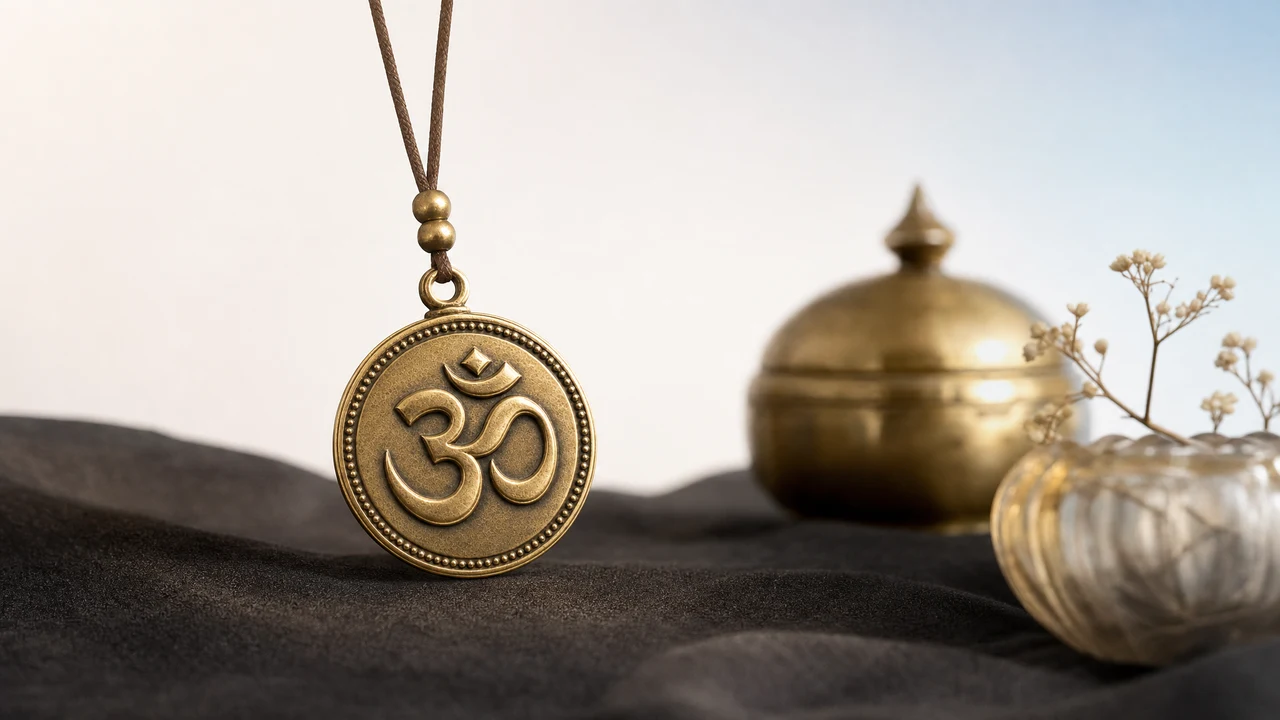
The Om symbol meaning is the first sound: Om, also written Aum, is widely understood as the primordial sound from which the whole universe unfolds. The Om symbol meaning goes beyond a single note, because the syllable is treated as a small map of reality, with parts that stand for states of being.
Most people know the shape and the sound without knowing what its pieces are said to represent. That is the part worth slowing down for.
What does the Om symbol mean?
Om is a sacred syllable shared across Hinduism, Buddhism, Jainism and Sikhism, though it is read a little differently in each. At its simplest it is the sound of the universe, the vibration underneath everything.
It is chanted at the opening and closing of prayers, mantras and meditation. The first sound is the phrase people reach for, because Om is treated as the beginning from which other sounds and forms arise.
The written symbol, in the Devanagari script, is instantly recognisable and appears on temples, pendants and doorways. Cast in brass, it is a common household object as well as a spiritual one.
What do the three sounds of Om represent?
Aum is often broken into three sounds: A, U and M. Each is given a meaning, and the most common reading maps them onto three states of consciousness.
A is linked to the waking state, U to the dream state, and M to deep, dreamless sleep. Together they are said to cover the whole of ordinary experience.
There is a second widely held reading tied to the divine. The three sounds are sometimes associated with creation, preservation and dissolution, and with Brahma, Vishnu and Shiva.
Interpretations of Om are many, and different schools and texts explain it in different ways. These readings are widely held rather than the single official answer, so take them as the common understanding, not a fixed doctrine.
What about the dot and the curve in the symbol?
The written Om is not just a squiggle; its parts carry meaning too. The symbol has curves, a dot at the top, and a crescent beneath the dot.
In one common explanation the three curves stand for the three states already named, waking, dream and deep sleep. A fourth state is often added, represented by the dot: a state of pure awareness beyond the other three, sometimes called Turiya.
The crescent below the dot is frequently read as maya, the veil of illusion that keeps the fourth state hidden. In that reading the whole symbol becomes a diagram of consciousness reaching toward its own silence.
The silence at the end of the sound
Something interesting happens when Om is chanted. After the A-U-M there is a moment of silence, and that silence is treated as part of the sound, not the absence of it.
That pause is where the "fourth state" is felt rather than described. It is the reason Om works so well as an opening and closing for meditation.
If you use Om at a desk, use the silence, not just the syllable. Sound the note once, then rest in the quiet after it for a breath before you start. That short silence does the same job as ringing a bell to open a task.
The bell tradition and Om are close relatives, both treating sound as a threshold, and the ghanta bell meaning guide covers the bell side of that idea.
How is Om used in daily practice?
Om is rarely used alone. It usually frames something else, sounded once before a mantra or a session and once at the close, like a pair of bookends around the work.
In yoga classes it often opens and ends the hour, chanted together by the room. That shared sound turns a group of strangers into a single, settled thing for a moment.
At home it appears on shrines, cast in brass or carved in wood, kept where the light can catch it. People touch it, pass it in the morning, or simply glance at it, and the glance is enough to bring the idea to mind.
Because Om is genuinely sacred to millions of people, it deserves care rather than casual use. Keep it clean, keep it respectful, and avoid treating it as a mere graphic. Using a sacred symbol thoughtfully is part of using it at all.
The syllable also appears inside longer, well-known phrases, where it opens the line. That opening position is the clue to its role, which is always to begin.
There is a reason people find the sound settling even without any belief attached. Making a low, sustained tone lengthens the out-breath, and a slow exhale is one of the oldest ways the body has to calm itself.
So Om does two things at once, one for the spirit and one for the nervous system. You can lean on whichever of those you find true and still get the benefit of the pause.
A brass Om at a working desk
A cast brass Om is a fixture in Indian homes, kept where its shape can catch the light. Its job there is to hold a little quiet in the room, a reminder of stillness in a busy day.
The honest line matters with a sacred symbol most of all. It is a charm, not a promise. An Om on your screen marks a moment and steadies you, the way a lucky pen or a pre-work routine does. It is not a spell over your day, and it should always be shown with respect for the traditions it belongs to.
Om among the charms of India
Om is less an object than a sound, which sets it apart from most charms. You cannot hang the sound, only the symbol that stands for it, and that gives it a different feel from a horseshoe or a bead.
Within the wider set of good luck superstitions in India, Om is the one most tied to inner state rather than outward fortune. It is about the mind of the person, not the luck around them.
Sound as a beginning is the thread it shares with bells and chants everywhere. Placed against the full range of lucky charm meanings around the world, Om stands out as the charm that points inward, and a daily desk ritual built around it borrows exactly that quiet.
What does the Om symbol mean?
Om, or Aum, is widely understood as the primordial sound from which the universe unfolds, the vibration beneath all things. It is a sacred syllable shared across several Indian religions and is chanted to open and close prayer and meditation.
What do the three parts of Aum represent?
The three sounds A, U and M are most commonly read as the waking, dream and deep-sleep states of consciousness. A second common reading links them to creation, preservation and dissolution, associated with Brahma, Vishnu and Shiva.
What does the dot on the Om symbol mean?
The dot at the top of the written symbol is often read as a fourth state, a pure awareness beyond waking, dreaming and deep sleep, sometimes called Turiya. The crescent beneath it is frequently understood as maya, the veil that hides that state.
Why is Om chanted at the start and end of practice?
Om is treated as a beginning and an ending, a threshold sound that opens and closes a session of prayer or meditation. The silence that follows the chant is considered part of it and is where the deepest state is felt.
Is Om only a Hindu symbol?
No, Om is shared across Hinduism, Buddhism, Jainism and Sikhism, though its meaning is read somewhat differently in each. It is one of the most widely recognised sacred symbols from the Indian subcontinent.
Does keeping an Om symbol bring good luck?
An Om is best understood as an invitation to stillness rather than a lucky object, and it is a charm, not a promise. It can steady and centre you before a task, but it does not control outcomes, and it deserves to be treated with respect.
Book My Luck today
Book My Luck is a desktop decoration for macOS 14+ and Windows 10/11. The desktop outside the charm remains clickable. The current Mac and Windows downloads are version 1.0.32, signed by KAK DIGITAL LLC. On Mac, Charm Centre controls size, cord length, placement, displays and motion. Collections and controls can differ between Mac and Windows.
There is no calendar integration, booked-moment scheduler or native-app free trial. Explore the website demo and regional pricing. One key activates one computer at a time; activation and license refresh require internet. Preferences are local, but purchasing, activation and website analytics use online services described in the privacy policy.
Hang one for the moment that matters
Book My Luck hangs a rendered charm from your Mac or Windows screen, with rope physics and manual interaction. Check the current platform release and regional price before buying.
Get Book My Luck →