Book My Luck
Nazar Boncuğu: Why the Turkish Evil Eye Is Blue
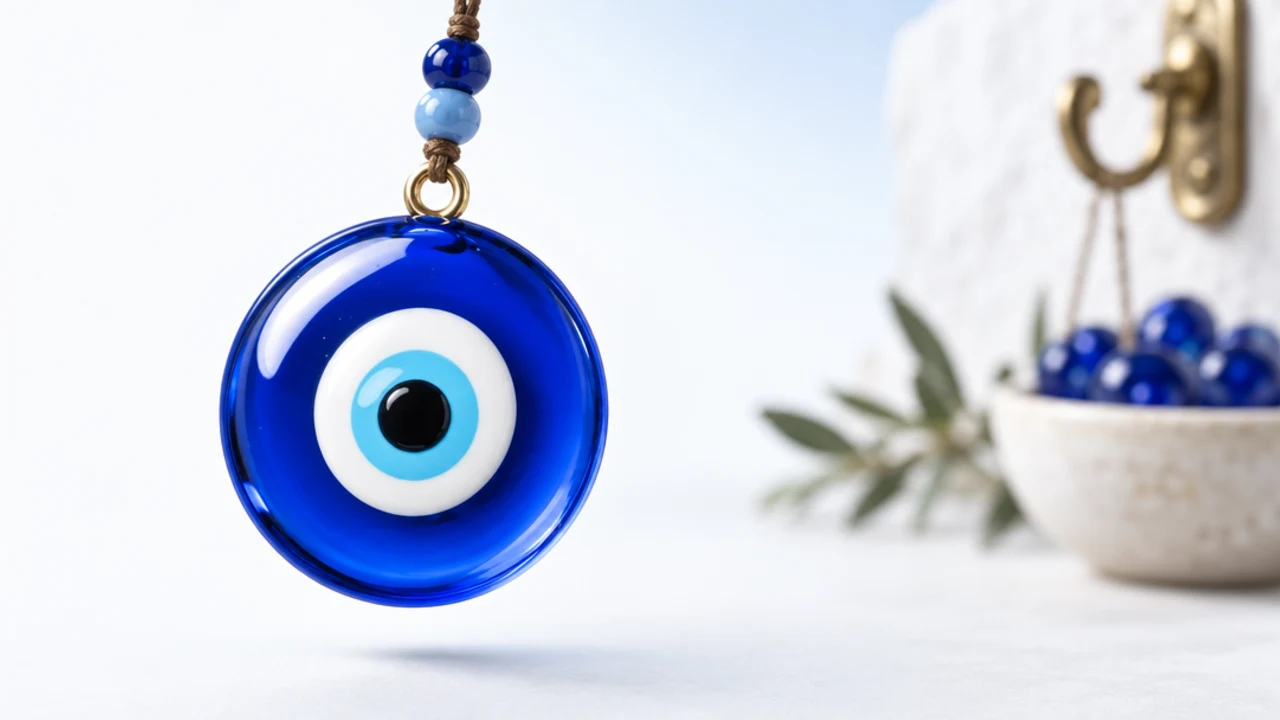
The nazar boncuğu meaning is protection: it is the Turkish blue glass bead shaped like an eye, hung to guard against an envious or admiring gaze. The word nazar means "gaze" or "look," and boncuk means "bead," so the name literally reads as "gaze bead."
Most people know the object without knowing the name. The blue eye on doorways and bracelets around the Mediterranean is the nazar boncuğu, and it has a specific job.
What is the nazar boncuğu meaning?
It is a charm that catches a harmful look before it settles. The belief is that envy, even friendly admiration, can carry bad luck, and the nazar draws that gaze toward itself.
So the nazar boncuğu meaning is not "curse" and not "eye of evil." It is a shield against the evil eye, the guard rather than the threat.
You will see it described as an amulet, a talisman, or simply a bead. All three fit, because it is a small object meant to protect by being worn or hung in plain view.
Nazar is the gaze. Boncuk is the bead. Together, the nazar boncuğu is the blue bead that catches an envious gaze so it does not land on you.
Why is the nazar boncuğu blue?
The color is not decoration. It ties to the eastern Mediterranean glass tradition, where cobalt and copper produced deep blues, and to the sense that blue is a cool, protective, watchful color.
Historically, blue glass was widespread in Anatolia and the wider region, so the material and the color grew up together. The classic bead has rings of dark blue, white, light blue, and a black center, which read clearly as an eye from across a room.
There is also a practical reading. Blue stands out against sun-bleached walls and doorways, so the guard is easy to notice, which is the point of a charm meant to draw the eye.
For the broader belief behind it, the evil eye meaning guide explains what the envious gaze is thought to do and why so many cultures guard against it.
How do you use a nazar boncuğu?
You hang it where admiration collects. A front door, a car mirror, a new shop, a cradle, a workbench.
The gesture in Book My Luck matches tradition: you give it a flick, and the bead sways on its cord. A moving charm feels more alive than a still one, which is part of why the flick sticks.
People also gift it. Handing someone a nazar is a quiet way to say "stay protected," so it turns up at housewarmings, births, and first days.
Place a nazar at eye level near an entrance, where it is easy to notice. A hidden charm cannot draw the gaze it is meant to catch.
Nazar or hamsa: which guards better?
Both are protective and both come from overlapping regions, so people ask which to choose. They do slightly different things, and they pair well.
Nazar boncuğu
- Form: a blue glass eye.
- Focus: the envious gaze specifically.
- Gesture: a flick to set it swaying.
Hamsa
- Form: an open hand, often with an eye in the palm.
- Focus: broader protection and blessing.
- Gesture: an open palm that says "enough."
Many charms combine them, setting a nazar in the center of a hamsa for both readings at once. The hamsa hand meaning piece covers palm-up versus palm-down if you want to go deeper.
Does the nazar boncuğu really work?
Here is the plain answer. It is a charm, not a promise, and it will not change an exam, a rival, or a result.
What it does is human-scale and real. It marks care and attention, gives worry a place to rest, and turns a vague fear into a small blue object you can look at before a nervous moment.
A charm someone gave you for protection carries their intention with it. That is worth respecting, and it can genuinely steady you, the way any small ritual does.
The tradition is ancient and shared, so it deserves plain, respectful description. Precise dates are hard to pin down, so it is fairer to say the belief and the bead are both very old across the Mediterranean.
It is a charm, not a promise. Never treat a nazar as a medical, financial, or exam guarantee. Its value is meaning and steadiness, not control over outcomes.
The nazar on your screen
The blue bead has moved from doorways to desks. A lucky charm app for Mac can hang a nazar boncuğu from the top of your screen, on a cord with real rope physics, so it sways and reacts to your cursor.
The ritual carries over. With Book My Luck you flick the bead, the traditional gesture, and it settles back to watching over your work.
For where the nazar sits among charms from Japan, Italy, Ireland, and India, the lucky charm meanings around the world guide lines them up with respect.
What are the parts of a nazar boncuğu?
Look closely and the classic bead is built in rings. A dark blue outer edge, a ring of white, a ring of light blue, and a black or dark dot at the center that reads as the pupil.
Those rings are what make it unmistakably an eye from a distance. The design is meant to be legible at a glance, so a passing gaze recognizes it instantly and lands there.
The traditional material is glass, and the making is part of the meaning. Molten glass is worked and layered by hand, so an older bead carries the maker's craft, not just a printed pattern.
Sizes range from tiny beads on a bracelet to large discs above a doorway. Bigger versions guard a whole home, while small ones travel with a person on a cord or a keyring.
For a doorway, choose a larger disc that is easy to see from the street. For a bag or a wrist, a small bead does the same job on a personal scale.
How does the nazar differ from a written charm?
Many protective traditions use words, verses, or written prayers folded into a locket. The nazar takes a different route by being purely visual.
It does not need to be read to work in the belief. It simply needs to be seen, which is why it suits doorways, mirrors, and now screens, where a glance is all it asks for.
That visual simplicity is part of why it travels so well across languages. A written charm belongs to the tongue it is written in, while a blue eye is understood anywhere.
A note on names and spellings
You will see nazar boncuğu, nazar boncuk, nazar amulet, and simply evil eye bead. These all point to the same object, with the Turkish spelling using the soft ğ.
In neighboring cultures the bead goes by other names, though the blue eye is recognizable across them. That shared look is part of why the charm reads instantly, whatever you call it.
You will also see the bead mass-produced today alongside older handmade glass. A machine-made bead carries the same meaning in use, though collectors often prize the handworked ones for their subtle imperfections.
None of that changes the job. Whether cheap or crafted, the nazar is hung to be seen, and its worth to the person hanging it lies in the care behind the gesture.
What does nazar boncuğu mean in English?
It translates roughly as "gaze bead" or "evil eye bead." Nazar means gaze or look, and boncuk means bead, so it is the bead that guards against an envious gaze.
Why is the evil eye bead blue?
The blue comes from eastern Mediterranean glassmaking traditions and the sense that blue is a cool, watchful, protective color. The classic bead layers dark blue, white, light blue, and a black center to read clearly as an eye.
Where should I hang a nazar boncuğu?
Hang it where admiration and envy collect, such as a front door, a car mirror, a new shop, or a workspace. Place it at eye level so it is easy to notice.
Is it bad luck if my nazar breaks?
A common belief is that a broken nazar has absorbed a strong dose of ill will and done its job. Most people simply replace it and treat the break as a good sign.
Is the nazar boncuğu only Turkish?
The blue glass bead is closely tied to Turkey and the wider Mediterranean, but the underlying evil eye belief is shared across many cultures. The bead is one recognizable form of a widespread idea.
Does a nazar boncuğu actually protect you?
It is a charm, not a promise. It marks care and steadies you before a tense moment, and it never claims to change a real outcome you cannot control.
Book My Luck today
Book My Luck is a desktop decoration for macOS 14+ and Windows 10/11. The desktop outside the charm remains clickable. The current Mac and Windows downloads are version 1.0.32, signed by KAK DIGITAL LLC. On Mac, Charm Centre controls size, cord length, placement, displays and motion. Collections and controls can differ between Mac and Windows.
There is no calendar integration, booked-moment scheduler or native-app free trial. Explore the website demo and regional pricing. One key activates one computer at a time; activation and license refresh require internet. Preferences are local, but purchasing, activation and website analytics use online services described in the privacy policy.
Hang one for the moment that matters
Book My Luck hangs a rendered charm from your Mac or Windows screen, with rope physics and manual interaction. Check the current platform release and regional price before buying.
Get Book My Luck →