Book My Luck
Drishti Bommai: The South Indian Guardian Explained
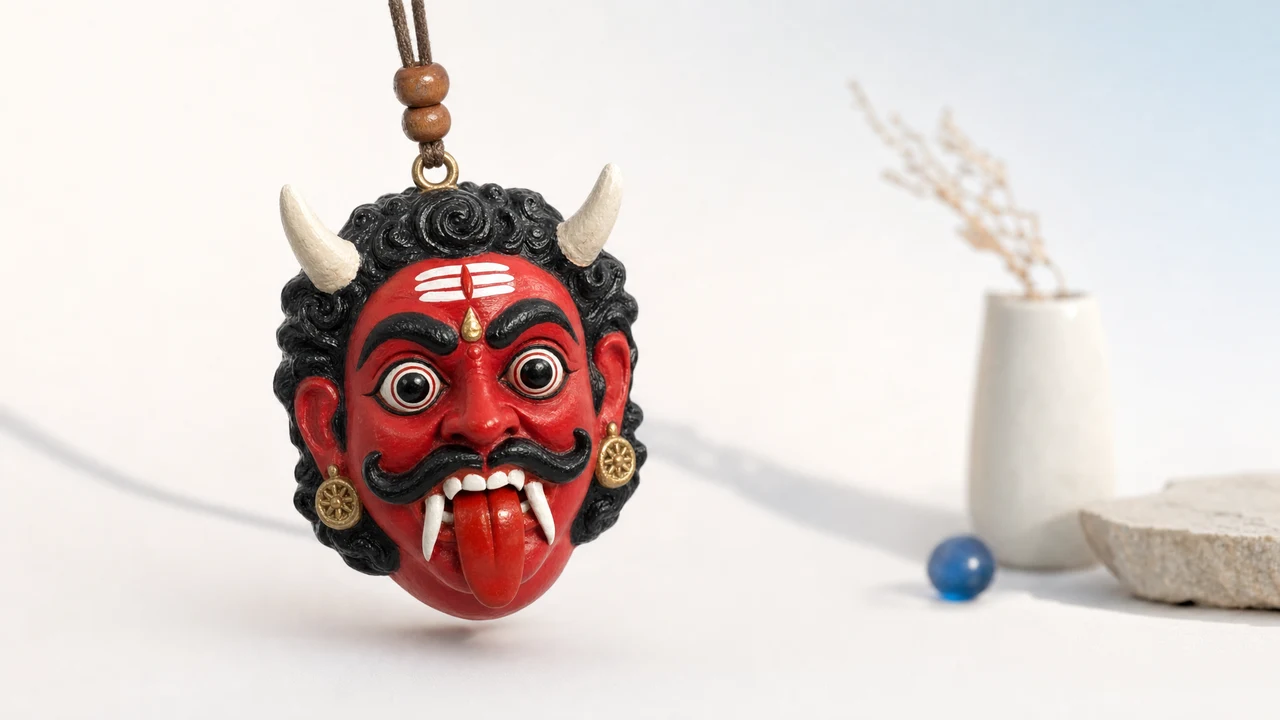
The drishti bommai meaning is protection: it is the fierce South Indian guardian face, hung on homes and buildings to absorb the evil eye and keep a hostile gaze away from the people inside. Drishti means "sight" or "gaze," and bommai means "doll" or "figure," so the name reads as "gaze figure."
Most people find the face startling and assume it is meant to scare visitors. It is really meant to catch the harmful look before it lands on anyone you love.
What is the drishti bommai meaning?
It is a protective figure tied to the belief in drishti, the harm carried by an envious or admiring gaze, known in Tamil as kannu and in the phrase kannu paduthal, roughly "being struck by the eye." The bommai is the countermeasure.
The drishti bommai meaning, then, is a guard that soaks up the evil eye. Its job is to be looked at, drawing the gaze toward itself and away from the household.
You see these faces on new houses, shops, and construction sites across South India. A new or prosperous building is thought to attract envy, so it gets a guardian.
Drishti is the harmful gaze. Bommai is the figure. The drishti bommai is the fierce face that catches that gaze so it does not fall on your family.
Why does the guardian look so fierce?
The exaggerated features are intentional. Bulging eyes, bared teeth, a wild grin, and bright paint are designed to be arresting, so any passing gaze snags on the face first.
The logic is the same one behind many evil-eye guards. A striking object draws the eye toward itself, taking the hit meant for the home.
Some versions are pumpkin-like gourds painted with a face, others are terracotta or plaster masks. The material varies by region and budget, but the arresting expression is the constant.
Place a drishti bommai high and visible, near the entrance or on a prominent wall, where an approaching gaze will meet it before it meets your door.
How does it relate to the evil eye elsewhere?
The core idea is shared far beyond South India. The belief that an envious look can bring harm appears around the Mediterranean, the Middle East, and South Asia, each with its own guard.
The Turkish blue bead and the South Indian guardian face answer the same worry in different visual languages. If you want the broad picture, the evil eye meaning guide explains the shared belief and how various cultures respond.
Within India, the drishti bommai often sits alongside other protections. Many homes also hang a nimbu-mirchi, the lemon-and-chili garland, so a household may layer more than one guard.
Drishti bommai or nazar: which fits your door?
Both are evil-eye guards, so people ask which to hang. They come from different regions and read differently.
Drishti bommai
- From: South India.
- Form: a fierce painted guardian face.
- Feel: a bold, arresting protector.
Nazar boncuğu
- From: Turkey and the Mediterranean.
- Form: a calm blue glass eye.
- Feel: a cool, watchful guard.
Both catch a hostile gaze; the difference is tone. The drishti bommai confronts, while the nazar quietly watches, so you can pick the mood you want at your threshold.
Does the drishti bommai actually protect a home?
Here is the honest answer. It is a charm, not a promise, and a painted face will not change a family's fortunes on its own.
Its value is human and real. Hanging a guardian marks care for a home and the people in it, and it gives a natural worry, envy of something new, a place to sit.
That intention is genuine and worth respecting. The face does nothing to actual odds, but it steadies a household the way any shared act of protection does.
The tradition is South Indian folk practice, held sincerely across many communities. Where customs and materials vary by region, it is fairer to describe the variation than to claim one form is the only correct one.
It is a charm, not a promise. Never treat a drishti bommai as a guarantee of any outcome. Its worth is in the care and attention it marks.
The guardian on your screen
The protective face has a place on the desktop too. A lucky charm app for Mac can hang a drishti bommai from the top of your screen, on a cord with real rope physics, so it sways and reacts to your cursor.
The ritual carries over. With Book My Luck you repaint the guardian, keeping its fierce watch fresh over your work.
For where the drishti bommai sits among charms from Turkey, Japan, Italy, and beyond, the lucky charm meanings around the world guide lines them up with respect.
What forms does the guardian take?
The drishti bommai is not a single object but a family of forms. The most striking is a painted gourd or pot with a fierce face, often hung on a building under construction.
There are also terracotta and plaster masks, molded with bulging eyes and bared teeth, fixed high on a wall. Some are small enough for a doorway, while others are large murals meant to guard a whole plot.
Scarecrow-like figures serve a related purpose in fields and building sites. A ragged effigy or a blackened pot draws the gaze away from the crop or the new structure, which is the same logic scaled up.
Color is deliberate throughout. Bright paint, bold outlines, and exaggerated features all serve one aim, to make the figure impossible to look past, so the gaze catches there first.
For a home, a compact terracotta face near the entrance is the usual choice. Larger gourd figures suit a construction site or a boundary wall.
How is a drishti bommai made and refreshed?
Many are hand-shaped from clay or papier-mâché, then painted in strong colors. The making is often local craft work, so styles differ from town to town.
The tradition also involves refreshing the guardian over time. Repainting a faded face renews its watch, which is the ritual Book My Luck echoes on screen when you repaint the guardian.
That upkeep is part of the meaning. Tending the figure is a way of tending the household's sense of protection, a small recurring act of care rather than a one-time hanging.
A note on names and forms
You will see drishti bommai, dishti bomma, and simply "evil eye doll" in English. Spellings shift across Tamil, Telugu, and other South Indian languages, and the figure goes by local names in each.
The gourd-face version and the terracotta-mask version are both common. That range reflects a living folk tradition rather than a single fixed object.
You will also notice the practice sits comfortably beside formal religion without competing with it. A household may keep a shrine indoors and a fierce guardian face outdoors, each doing its own kind of work.
That everyday, practical quality is part of the charm's appeal. It is less about doctrine and more about a family's ordinary wish to keep a new home and its people safe.
Treating it with respect means describing it plainly. The belief is sincere, widely held, and worth understanding on its own terms rather than as a curiosity.
What does drishti bommai mean?
It means "gaze figure," from drishti meaning sight or gaze and bommai meaning doll or figure. It is a South Indian guardian face hung to absorb the evil eye.
Why is the drishti bommai face so scary?
The fierce features are intentional, designed to catch a passing gaze so it lands on the figure rather than the home. A striking face draws the eye toward itself, which is the point.
Where do you hang a drishti bommai?
High and visible near an entrance, or on a prominent wall of a home, shop, or building under construction. New or prosperous buildings are thought to attract envy, so they get a guardian.
Is the drishti bommai the same as the Turkish evil eye?
They answer the same belief in the harm of an envious gaze, but in different forms. The drishti bommai is a fierce painted face from South India, while the nazar is a calm blue glass bead from the Mediterranean.
Can I use a drishti bommai with other charms?
Yes, and many homes do. It is common to hang a guardian face alongside a lemon-and-chili garland, layering more than one protection.
Does a drishti bommai actually work?
It is a charm, not a promise. It marks care for a home and steadies a household, and it never claims to change a real outcome you cannot control.
Book My Luck today
Book My Luck is a desktop decoration for macOS 14+ and Windows 10/11. The desktop outside the charm remains clickable. The current Mac and Windows downloads are version 1.0.32, signed by KAK DIGITAL LLC. On Mac, Charm Centre controls size, cord length, placement, displays and motion. Collections and controls can differ between Mac and Windows.
There is no calendar integration, booked-moment scheduler or native-app free trial. Explore the website demo and regional pricing. One key activates one computer at a time; activation and license refresh require internet. Preferences are local, but purchasing, activation and website analytics use online services described in the privacy policy.
Hang one for the moment that matters
Book My Luck hangs a rendered charm from your Mac or Windows screen, with rope physics and manual interaction. Check the current platform release and regional price before buying.
Get Book My Luck →