Book My Luck
Evil Eye vs Hamsa: What Is the Difference?
Evil eye vs hamsa comes down to this: the evil eye is the envious stare people have feared for centuries, along with the blue glass charm made to reflect it, while the hamsa is a protective hand-shaped amulet that often carries an eye in its palm. One names the threat and its counter; the other is a guardian shape that frequently uses that same eye inside it.
Most explanations treat them as rivals, which is the wrong frame. In practice they come from overlapping cultures and are often worn together.
What is the evil eye?
The evil eye is a very old belief that an envious or ill-wishing look can bring harm. It appears across the Mediterranean, the Middle East, South Asia and beyond, under many names.
The charm most people picture is the nazar boncuğu, the blue glass bead with a dark centre. It is designed to look back at the world, catching a harsh glance before it lands.
So the phrase "evil eye" covers two things at once. It is both the curse people fear and the blue charm made to turn that curse away.
If you want the fuller history, the evil eye meaning traces the belief from ancient times to the beads sold on every corner today.
Blue is common in the classic bead but not required. What matters in the tradition is the eye-looking-back, not the exact colour.
What is the hamsa?
The hamsa is an open right hand, usually shown flat and symmetrical, often with the two outer fingers as thumbs. It is worn and hung across the Middle East and North Africa.
It carries different names in different faiths. In Islam it is often the Hand of Fatima; in Judaism it is often the Hand of Miriam, and it is beloved in many communities beyond those.
The hand itself is the protection. The hamsa is a "stop" gesture against harm, a palm held up between you and whatever might wish you ill.
The deeper reading of fingers, faiths and direction lives in the hamsa hand meaning, which is worth a read if the hand is the charm that draws you.
Where do the two overlap?
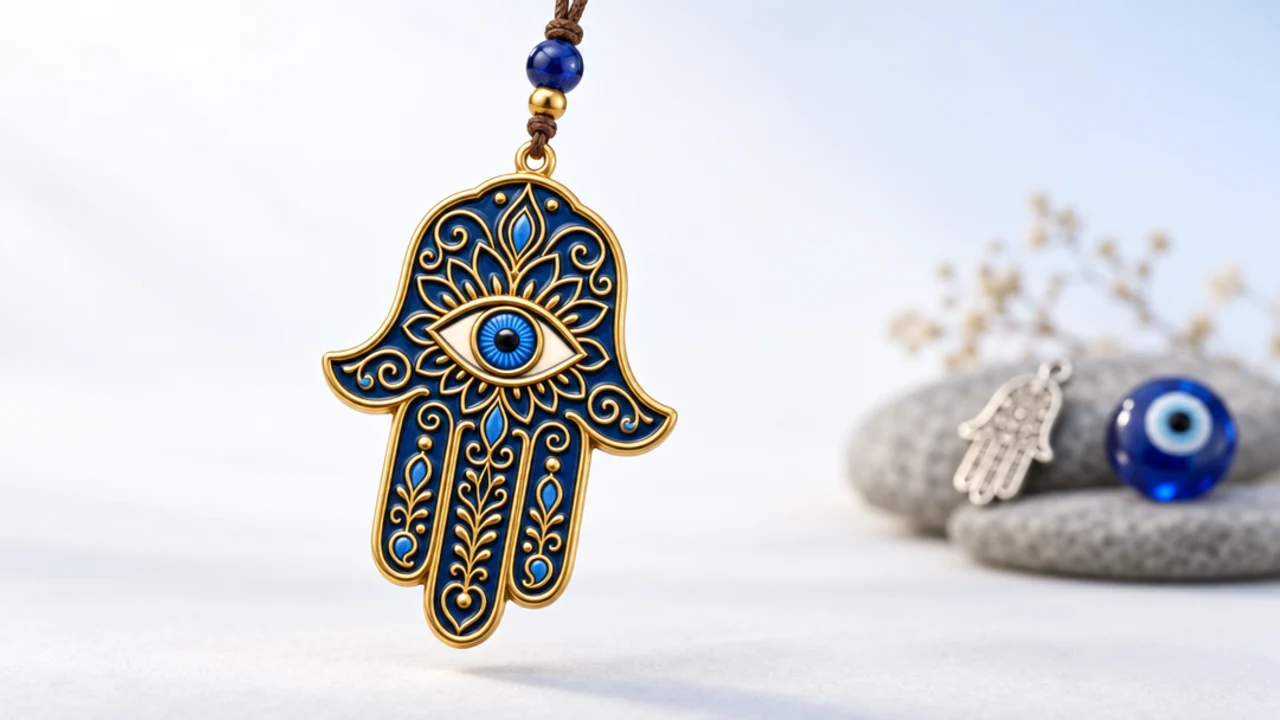
Here is the part that confuses people. The hamsa very often has an eye drawn or set into the centre of its palm.
That eye is, in most cases, the evil eye — the same watching, reflecting eye from the nazar. So a single hamsa can contain both symbols in one object.
This is why "evil eye vs hamsa" is a slightly false contest. The hamsa is frequently a frame, and the evil eye is the guardian it holds.
A hamsa with an eye in the palm is not a mix-up. It is a common, traditional design that layers a protective shape over a protective glance.
Evil eye and hamsa, compared
When they are used as separate charms, they do have distinct characters. Here is the plain comparison.
The evil eye (nazar)
- Form: a round bead, classically blue glass with a dark pupil
- Idea: reflect an envious glance back before it can harm
- Roots: Mediterranean, Middle East, South Asia, very widespread
- Feels like: a watchful mirror facing outward
The hamsa
- Form: an open, symmetrical hand, often with a palm eye
- Idea: a raised palm that blocks and turns away harm
- Roots: Middle East and North Africa, across several faiths
- Feels like: a guardian standing between you and trouble
The two together
- Form: a hamsa with a nazar set into the palm
- Idea: a blocking hand that also reflects the glance
- Roots: the shared cultures where both charms grew up
- Feels like: belt and braces, protection doubled
For the wider family these belong to, middle eastern protection symbols sets the hamsa and nazar next to their neighbours.
Evil eye vs hamsa: which should you choose?
Choose by feel, because neither outranks the other. Some people connect with the watching bead; others want the steady hand.
If you like a single clean image, the nazar bead is hard to beat, and the nazar boncugu meaning explains why the blue version became the icon it is. If you want something that reads as a guardian figure, the hamsa has more presence.
There is also the honest question of respect. Both are living symbols in real faith communities, so wear or hang either with care and never as a costume.
If you cannot decide, pick the hamsa with an eye in the palm. It is the traditional two-in-one, so you are not choosing at all.
However you choose, remember what a charm can and cannot do. A charm is not a promise: it steadies you and marks the moment, the way a lucky ritual does, but it makes no claim on the result.
That modesty is the point. A calmer, braver you is the real thing either charm delivers, and that is worth having on a hard day.
Can you keep both on your screen?
You can, and many people do exactly that in physical form at a doorway. The two are companions far more often than they are alternatives.
If you would rather they lived on your desk than by your door, a screen charm can hang either one from the top of your display. In Book My Luck the Nazar boncuğu and the Hamsa are both among the named charms, each with its own small ritual, so you can keep the one that fits or switch by the day.
The choice is personal and the meaning is old. Pick the guardian that speaks to you, treat its tradition kindly, and let it do its quiet, steadying work.
Where did these two charms come from?
Both charms grew out of a shared corner of the world, which is why they overlap so much. The eastern Mediterranean and the Middle East were a crossroads of trade and belief for thousands of years, and ideas about protection travelled with the people.
The evil eye belief is one of the oldest and most widespread of all. Versions of it appear across ancient Greece, Rome, the Middle East and South Asia, which is why so many countries have their own word and their own charm for it.
The hamsa is more specifically tied to the hand as a symbol. The open palm has stood for protection in the region for a very long time, and it was adopted and loved across several faiths as they grew up alongside one another.
Because the roots are ancient and shared, precise "who invented it" claims are shaky. It is fairer to say these charms were shaped by many hands over many centuries than to hand either one a single origin.
When a symbol is this old and this widespread, treat confident origin stories with care. The honest position is that both the evil eye and the hamsa are commonly held traditions with deep, tangled histories rather than tidy start dates.
How do you use either charm with respect?
Respect starts with naming the charm correctly and knowing roughly where it comes from. A nazar is not just "a blue thing," and a hamsa is not just "a hand"; each belongs to living communities.
Avoid using either as an empty aesthetic while ignoring its meaning. You do not have to share the belief to honour it, but you should not strip it of meaning entirely.
A good test is whether you could explain the charm kindly to someone from its home culture. If you can say what it means and why you keep it, you are using it well.
This matters more, not less, when the charm is digital. A screen charm is easy to treat as a toy, so it is worth keeping the real story in mind even there.
Used that way, either charm becomes a small, honest companion. It steadies you, marks your moments, and carries a piece of a long human habit of wishing each other safe.
FAQ
Is the hamsa the same as the evil eye?
No, but they are closely linked. The hamsa is a protective hand, while the evil eye is the envious stare and its reflecting charm. The confusion comes from the eye that is often placed inside the hamsa's palm.
Can you wear a hamsa and an evil eye together?
Yes, and it is common. Many hamsas already contain an evil eye in the palm, and plenty of people also wear a separate nazar bead. Using both is traditional, not contradictory.
Which is better for protection, the hamsa or the nazar?
Neither is stronger; they simply feel different. The nazar is a watchful mirror facing outward, and the hamsa is a raised, blocking hand. Choose the one whose image steadies you most, or use the hamsa with an eye to get both.
Does the hamsa belong to one religion?
No. The hamsa is honoured across several faiths, often called the Hand of Fatima in Islam and the Hand of Miriam in Judaism, and it is loved in many communities beyond those. Treat it with respect for all of them.
Why is the evil eye charm blue?
Blue is the classic colour of the nazar bead, though the tradition centres on the reflecting eye rather than the colour itself. Blue glass simply became the familiar, recognisable form over time.
Do these charms actually work?
They work as rituals, not as guarantees. A charm is not a promise; it steadies your nerves and marks a moment, much like a pre-game routine. Any real outcome is still yours to earn.
Hang one for the moment that matters
Book My Luck hangs a rendered charm from your Mac or Windows screen, with rope physics and manual interaction. Check the current platform release and regional price before buying.
Get Book My Luck →