Book My Luck
Lucky Charm for a Presentation or Pitch
A lucky charm for presentation nerves works by calming you and steadying your voice, never by delivering the talk for you. What speakers actually use is small and personal: a token in a pocket, a ring turned once, or a familiar object that says "you have practised this, you are ready."
Most presentation advice is about slides and structure, which matter but do nothing for the dry mouth two minutes before you go on. A charm fills that gap, because stage fright is a body problem more than a content problem.
Why does a lucky charm for presentation nerves help?
Speaking in front of people triggers a real fear response. Your heart races, your breath goes shallow, and your voice tightens exactly when you need it steady.
A charm interrupts that response with a fixed point of focus. Touching a familiar object slows the spiral enough for your rehearsed opening to come back to you.
This is why seasoned speakers so often have a pre-stage ritual. The charm does not write your talk; it lets the prepared speaker show up instead of the panicked one.
A charm is not a promise. It will not make a weak talk strong or an unpractised one smooth. It steadies the nerves that would otherwise flatten a talk you know well.
What lucky charms do speakers use?
A lucky charm for presentation use should be discreet and portable. A stage is no place for anything fussy, so speakers pick items they can hold or glance at without breaking their flow.
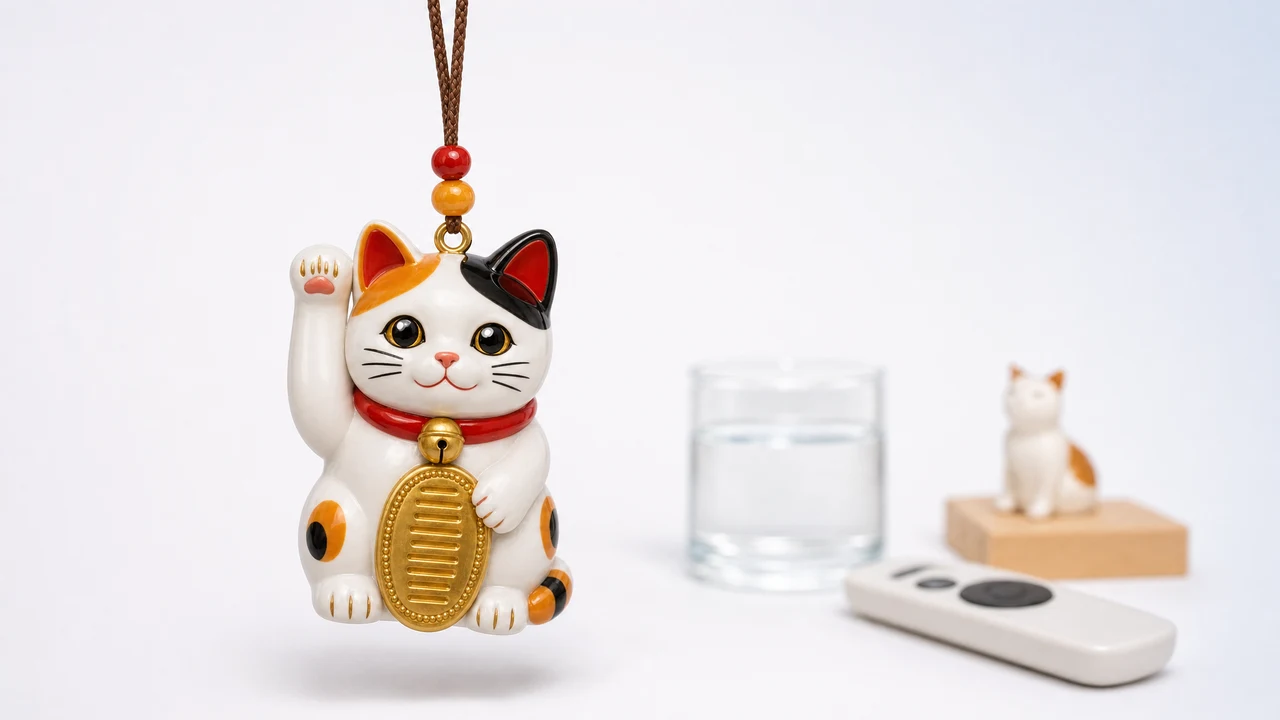
Common choices are a pocket coin, a ring, a bracelet, or a small figure kept near the lectern. The maneki-neko, the beckoning cat, is a favourite because it stands for inviting good fortune and a warm reception.
If that cat draws you, the maneki-neko meaning explains which paw is raised and why, and why it became a charm for welcoming people in.
Keep the charm where you can reach it without looking, like a pocket or beside your notes. A charm you have to hunt for mid-talk becomes a distraction, not a comfort.
Three ways to carry calm onto the stage
Speakers steady themselves in different ways. Here are three approaches and who each suits.
The pocket token
- What it is: a coin or small keepsake you squeeze before you begin
- Why it works: a private touch resets you without the audience seeing
- Best for: speakers who calm down through a quiet physical cue
The lectern companion
- What it is: a small figure or charm set beside your notes
- Why it works: a familiar object makes a strange stage feel like home
- Best for: speakers who like an anchor in their eyeline
The backstage ritual
- What it is: a fixed breath and phrase you do just before walking on
- Why it works: it draws a clean line between waiting and performing
- Best for: speakers who want a strong "begin" signal
Across all three, repetition is the engine. An object becomes calming only by being used the same way, talk after talk.
How do you rehearse with a charm?
Bring the charm into your practice runs, not just the real thing. If you only meet it on stage, it carries no meaning yet.
Hold or wear it while you rehearse your opening lines. By the day of the talk, the object already means "I know how this starts," so it steadies you where nerves hit hardest.
This is the same anchoring behind any solid desk ritual: a fixed cue attached to focused work. A presentation is a high-stakes version of the same habit.
Rehearse the first minute more than any other. If your opening is smooth, your nerves settle fast, and the charm's job is mostly to get you cleanly into that opening.
The calm you need overlaps closely with other high-pressure talking, so the routine in lucky charm for a job interview transfers almost directly to a pitch.
Does an online presentation change the approach?
The nerves are the same; the setting is friendlier. For a remote talk, your stage is your own desk, which you control completely.
You can set your charm and your routine exactly where the call happens. A token by the keyboard, a breath before you unmute, a glance at something steadying: all of it fits your own space.
For a launch that includes a live demo or keynote, the same steadiness feeds into a good luck charm for launch day. Carry it all lightly. The charm gets you calmly to your first line; the talk is yours from there, and you are more ready than the pre-stage nerves are telling you.
What do you do if nerves hit mid-talk?
Even a well-prepared speaker can lose the thread partway through. The recovery matters more than the stumble, and a small anchor helps you find your feet again.
A quiet touch of your charm, or a beat of the breath you practised, buys you a second to reset. The audience reads a short pause as confidence far more often than as a mistake.
Have a fallback line ready for these moments. A calm "let me come back to that" costs you nothing and hides a lot, and it beats spiralling in front of the room.
Water is your other friend here. Reaching for a glass is a socially invisible way to pause, breathe, and let your next point come back to you.
Do not fiddle with the charm all the way through the talk. One reset touch is steadying; constant fidgeting reads as anxiety and pulls the eye. Use it, then let your hands settle.
How do you build real confidence, not just a lucky feeling?
A charm is the last mile, but the road before it is preparation. The most reliable cure for stage fright is knowing your material well enough that you could survive losing your slides.
Rehearse out loud, not just in your head, and ideally in front of one kind person. Speaking the words aloud is what wires them in, and it exposes the lines that only sounded good on paper.
Then let the charm hold the nerves that remain. Preparation removes most of the fear; the ritual manages the rest, and together they let the real you speak.
Over many talks, the confidence compounds. Each time you walk on steady and get through it, the next one feels a little less like a threat and a little more like a conversation.
That is the quiet goal behind any speaking charm. Not to fake calm once, but to help you build the genuine kind, one talk at a time.
It helps to remember that the audience is usually on your side. Most people in a room want the speaker to do well, because a good talk is a better use of their time than a bad one.
So the charm is really steadying you against your own imagination, not against a hostile crowd. The fear is almost always larger than the room, and a small cue that reminds you of that is worth keeping close.
What is a good lucky charm for a presentation?
Something small, personal and discreet, such as a pocket coin, a ring, or a small figure by your notes. Familiarity is what matters, so pick one you can touch or glance at to reset without breaking your flow.
Do lucky charms help with stage fright?
They help indirectly by calming the body's fear response, which lets your practised words come through. A charm cannot make an unprepared talk good, but a steadier speaker connects better and recalls their opening more easily.
How do I calm my nerves before speaking?
Breathe slowly with a long out-breath, repeat one grounding sentence, and touch a familiar charm as your signal to begin. Rehearse your first minute heavily, since a smooth opening settles the rest.
Should the charm be visible during the talk?
Usually not. A discreet pocket token or a small object by your notes works best, because anything showy can distract you or the audience. The comfort should be private.
Can I use a charm for an online pitch?
Yes, and your own desk makes it easier. Keep a token nearby, breathe before you unmute, and glance at something steadying. A charm on your screen can act as the same "begin now" cue.
Will a lucky charm make my pitch succeed?
No. A charm is not a promise and cannot change the strength of your idea or your slides. Use it to arrive calm and present, then let your preparation and delivery carry the pitch.
Book My Luck today
Book My Luck is a desktop decoration for macOS 14+ and Windows 10/11. The desktop outside the charm remains clickable. The current Mac and Windows downloads are version 1.0.32, signed by KAK DIGITAL LLC. On Mac, Charm Centre controls size, cord length, placement, displays and motion. Collections and controls can differ between Mac and Windows.
There is no calendar integration, booked-moment scheduler or native-app free trial. Explore the website demo and regional pricing. One key activates one computer at a time; activation and license refresh require internet. Preferences are local, but purchasing, activation and website analytics use online services described in the privacy policy.
Hang one for the moment that matters
Book My Luck hangs a rendered charm from your Mac or Windows screen, with rope physics and manual interaction. Check the current platform release and regional price before buying.
Get Book My Luck →