Book My Luck
Himmeli Meaning: The Finnish Straw Mobile for Luck
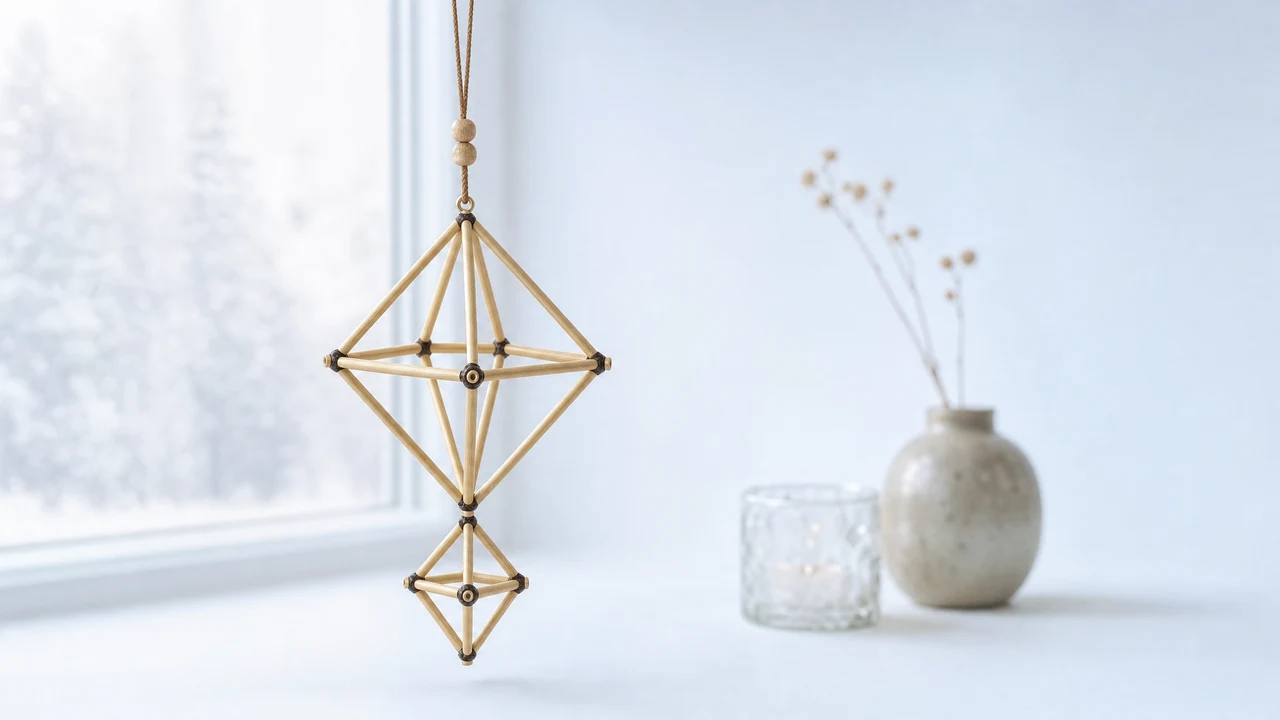
The himmeli meaning is abundance: it is a Finnish mobile of geometric straw shapes, hung to promise a good harvest and a prosperous year. The himmeli meaning is tied to the land and the seasons, which is why it is made from the year's own straw and hung above the table where the family eats.
Most people see a himmeli as a stylish geometric ornament, and it is one. Its roots run into farmhouse winters and the hope for next year's grain.
What is a himmeli?
A himmeli is a hanging mobile built from lengths of straw threaded together into open, three-dimensional geometric shapes. The classic unit is a diamond or octahedron, and these are often joined into larger clusters that turn slowly in the air.
It is traditionally made from rye straw, the stalks left after the grain harvest. The year's own straw is part of the meaning, since the ornament is quite literally built from the season that has just passed.
The name is thought to come from the Swedish word himmel, meaning sky or heaven, which suits an object hung high and left to drift. It is a shared Nordic and Baltic tradition, strongest in Finland.
Why is a himmeli hung for luck?
The himmeli was above all a harvest and Yule ornament, hung over the dining table at midwinter. It stayed up through the season, sometimes until well into the following year.
The belief attached to it was agricultural. A himmeli was thought to promise a good harvest in the coming season, and folk custom held that a larger himmeli meant a more generous crop.
A good harvest was the whole wish. In a farming culture through a long, dark winter, hope for the next year's grain was hope for survival itself.
This is folk tradition rather than doctrine, and customs varied from region to region and household to household. The link between the himmeli and a good harvest is the widely held core; the finer details differ by telling.
Hanging it over the table put the wish at the centre of family life, above the food itself. The slow turning of the mobile in the warm air of the room was part of its quiet charm.
What do the shapes mean?
The himmeli's beauty is its geometry: clean straight lines of straw forming diamonds, stars and stacked polyhedra. The open structure lets light through and casts shifting shadows as it moves.
There is no single fixed code for the shapes, and much of the meaning is aesthetic and seasonal rather than symbolic in a line-by-line way. The whole object, hung and turning, is the symbol, more than any one facet of it.
If you want to try the tradition, a small himmeli is a good winter project, and rye or wheat straw softened in water bends without snapping. Building one by hand is itself a slow, calming ritual, which is half of what these seasonal objects are for.
Because it is made of straw and thread, a himmeli is light, and even a small draught keeps it moving. That gentle motion is why it works so well as a charm you glance up at.
How is a himmeli made?
The building block of a himmeli is simple: a straw, threaded onto a length of thread or thin wire, joined end to end into a shape. The classic shape is a diamond made of straws of equal length.
From that single unit, everything else follows. Straws and thread are the whole material list, and larger himmeli are just many diamonds joined into stacks and clusters.
Traditionally the maker worked with rye straw softened in water so it would bend without cracking. Today people use paper straws, brass tubes or wooden dowels, but the geometry stays the same.
If you build one with natural straw, keep it dry, since damp straw softens and sags and can grow mould. A himmeli is meant to hang in dry indoor air, which is exactly where a heated winter home provides.
The finished mobile is balanced so it hangs level and turns freely. Getting that balance right, so it drifts rather than tilts, is the quiet skill of the craft.
A harvest charm meets a working desk
A straw himmeli belongs to a farmhouse ceiling and a Finnish winter. The feeling behind it, a small object hung overhead that carries a hope for the year, translates surprisingly well to a modern desk.
If you like the look, the lucky desk setup guide covers where charms, plants and small objects sit best around a workspace. A himmeli suits a calm corner where it can turn in the air from a heater or a window.
There is also a screen version of the same idea. Book My Luck is a Mac menu-bar app that hangs a charm from the top edge of your display on a thin cord with real rope physics, and the himmeli is one of its twenty named charms, rendered as a fine straw mobile that sways as you move the cursor.
The honest line applies to the himmeli as much as to any charm. It is a charm, not a promise. A himmeli marks the turning of a season and steadies the mood of a room, the way a lucky pen or a pre-game ritual does. It never controlled a real harvest, and it will not control a real outcome for you.
The charm clicks straight through so it never blocks your work, and it lives behind a small icon in the menu bar with no account and no telemetry. There are twenty named charms plus any emoji you like, sold as a single one-time purchase with no subscription.
Where the himmeli sits among winter charms
The himmeli belongs to a family of northern midwinter customs, where light, greenery and hope for the returning sun all gather around the darkest days. Wreaths, candles and evergreen boughs share the same instinct.
Himmeli
- Made of: rye straw and thread
- Hung: over the dining table at Yule and harvest
- Wish: a good harvest and a prosperous year
The Yule wreath
- Made of: evergreen boughs
- Hung: on doors and walls in midwinter
- Wish: life and welcome through the dark season
Candlelight
- Made of: wax and flame
- Placed: in windows and on tables
- Wish: the return of light as the days lengthen
All three answer the same northern winter with warmth and hope. For the deeper history of just the straw mobile, the Finnish himmeli tradition guide goes further into its place in the Nordic year.
A charm of the seasons
The himmeli is unusual among charms because it is so plainly tied to time. It is made when the grain is cut, hung in the deep of winter, and set aside as the year turns.
A charm of the seasons is a good way to describe it. It marks the passage of a year the way a bell marks the start of a moment.
Seen among the full range of lucky charm meanings around the world, the himmeli is the one that ties luck to the harvest and the calendar. Building one, or keeping a small one where you work, is a quiet way to acknowledge that a year has weight, which is the same spirit as any daily desk ritual.
FAQ
What does a himmeli symbolise?
A himmeli symbolises abundance and the hope for a good harvest in the coming year. It is a Finnish straw mobile traditionally hung over the dining table at Yule and harvest time.
What is a himmeli made of?
A himmeli is traditionally made from rye straw, the stalks left after the grain harvest, threaded together into geometric shapes. The straw is light and, when softened, bends into diamonds and stars without breaking.
Why is a himmeli hung over the table?
Hanging it over the dining table placed the wish for a good harvest at the centre of family life, above the food itself. It stayed up through the Yule season, turning slowly in the warm air of the room.
Does the size of a himmeli matter?
Folk belief held that a larger himmeli promised a more generous harvest, so size carried meaning in the tradition. This is a widely held custom rather than a strict rule, and interpretations varied by region.
Where does the name himmeli come from?
The name is generally traced to the Swedish word himmel, meaning sky or heaven, which fits an object hung high and left to drift. The tradition is strongest in Finland but shared across the Nordic and Baltic region.
Is a himmeli actually lucky?
A himmeli is a charm, not a promise, and an honest answer says so. It marks the turning of the season and brings a calm, hopeful feeling to a room, but it does not control a harvest or any other outcome.
Hang one for the moment that matters
Book My Luck hangs a real lucky charm from the top of your Mac screen. It sways, clicks through, and drops in on cue for the moments you book. One purchase, no subscription.
Get Book My Luck →