Book My Luck
Dreamcatcher Meaning: What the Web and Feathers Do
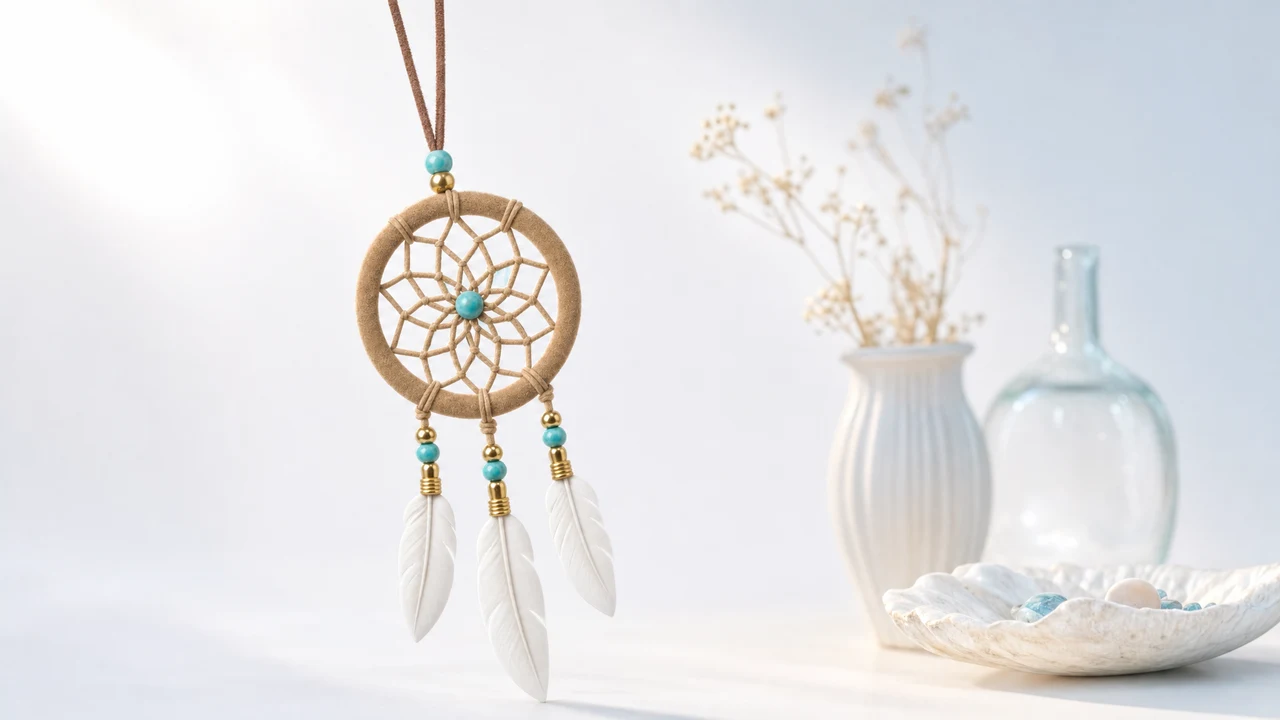
The dreamcatcher meaning is protection over sleep: a woven web inside a hoop is said to catch bad dreams while good dreams pass through to the person below. The dreamcatcher meaning belongs to the Ojibwe people of North America, and understanding it well means starting with that origin rather than the version sold in gift shops.
Most explanations skip straight to "catches bad dreams." The fuller story, and the respect it asks for, is the point of this piece.
Where does the dreamcatcher come from?
The dreamcatcher originates with the Ojibwe, also known as the Anishinaabe, one of the Indigenous nations of North America. In the Ojibwe language a word for it, asabikeshiinh, relates to the spider.
The traditional form is a hoop, often of bent willow, holding a woven net or web, decorated with feathers and sometimes beads. A woven web inside a ring is the heart of it, and the web is the working part of the charm.
Over the twentieth century the dreamcatcher spread to many other Native nations and then far beyond, which is where a lot of confusion and commercialisation began.
What is the story behind it?
The most widely told story features Asibikaashi, a Spider Woman figure sometimes called the Spider Grandmother. In the telling, she watched over the people, especially the children, weaving her protective webs.
As the nation grew and spread across a wide land, it became hard for her to reach every cradle. Mothers and grandmothers began weaving webs of their own to hang over the children, so that her protection could continue.
Oral traditions differ between communities and tellers, and there is no single authorised version. This is the widely shared account; the specific details vary, and the tradition properly belongs to the Ojibwe and related peoples.
That origin is why the dreamcatcher is bound up with care, family and the safety of sleep. It was never a generic good-luck trinket.
How is the web and the feathers supposed to work?
The belief attached to the dreamcatcher is elegant. The web is said to catch bad dreams as they drift toward a sleeping person, tangling them in its threads.
The good dreams, meanwhile, are said to find their way through the small opening in the centre and slide gently down the feathers to the sleeper below. Good dreams pass through while bad ones are held.
Then dawn does the rest. In many tellings the bad dreams caught in the web dissolve or perish in the first light of morning, so the web is cleared for the next night.
It is a beautiful piece of logic, whichever way you read it. The web sorts the night's dreams, the feathers deliver the good ones gently, and the sun resets the whole thing each day.
Part of what makes the image last is how kind it is. There is no punishment in it, only a soft filter between a sleeping person and the things that might trouble them.
If you keep a dreamcatcher, the traditional place is above where you sleep, hung so the morning light can reach it. That detail is not decoration; the daylight is part of how the charm is said to work.
A note on respect
The dreamcatcher is not folklore that belongs to everyone. It is a living tradition of specific Indigenous peoples, and mass-produced versions have drawn real and fair criticism for stripping it of meaning.
If the dreamcatcher speaks to you, the respectful path is to learn its origin, to buy from Indigenous makers where you can, and to describe it accurately. Treating it as a cheap novelty is exactly what many Native communities have asked people not to do.
A little care costs nothing and changes everything. Knowing whose tradition you are borrowing, and saying so, is the difference between honouring a charm and hollowing it out.
That same care applies to any protective charm from a living culture, which is a thread that runs through the evil eye meaning guide as well. Respect is part of using these symbols at all.
What are the parts of a dreamcatcher?
Every element of the traditional dreamcatcher has a role, which is part of why it rewards a closer look. The hoop, the web, the beads and the feathers each carry meaning.
The hoop itself, often a bent willow ring, is sometimes read as the circle of life or the movement of the sun and moon through a day. The circle is the frame that holds everything else together.
The woven web inside is the working part, patterned loosely like a spider's own. Any beads worked into it are read in different ways by different tellers, sometimes as the good dreams held in the web, sometimes simply as ornament.
The feathers hang below the hoop and are the soft path down which good dreams are said to travel to the sleeper. In some tellings the kind of feather mattered, tied to particular birds and their qualities.
Some materials in older dreamcatchers, including certain feathers, are legally protected and culturally significant. This is another reason to buy from Indigenous makers who understand what is appropriate, rather than from mass producers who do not.
Where the dreamcatcher sits among protective charms
The dreamcatcher belongs to a broad family of charms meant to guard a vulnerable moment, in its case the helplessness of sleep. It helps to see how it compares to others in that family.
| Charm | Guards | Where it hangs |
|---|---|---|
| Dreamcatcher | Sleep, from bad dreams | Above the bed or cradle |
| Nazar (evil eye) | People, from envious glances | Doorways, walls, worn on the body |
| Horseshoe | A household, general luck | Above a door, points up |
Each protects a different soft spot in life. The dreamcatcher's soft spot is the night, which is what makes it distinct among the world's charms.
For the full spread, the lucky charm meanings around the world guide places the dreamcatcher beside charms from every continent, each guarding its own moment.
A charm that hangs, on a screen
The dreamcatcher is defined by hanging: a hoop suspended above you, turning slowly, catching what drifts by. That physical fact, an object that hangs and sways overhead, is one a screen can echo.
Book My Luck is a Mac menu-bar app that hangs a charm from the top edge of your display on a thin cord with real rope physics, so it sways and reacts to your cursor. The way an object dangles and moves on screen is covered in the hanging charm on Mac screen guide, if the mechanics interest you.
The honest line is essential for a charm with this history. It is a charm, not a promise. A dreamcatcher marks a wish for peaceful rest and carries a beautiful story, the way a lucky pen or a small ritual does. It does not control your dreams or your luck, and it should always be shown with respect for the Ojibwe people it comes from.
What does a dreamcatcher actually do?
By tradition, the woven web catches bad dreams as they drift toward a sleeper, while good dreams pass through the centre opening and slide down the feathers to the person below. In many tellings the caught bad dreams dissolve in the morning light.
Where does the dreamcatcher come from?
The dreamcatcher originates with the Ojibwe, or Anishinaabe, an Indigenous nation of North America. It later spread to many other Native peoples and beyond, but its roots and deepest meaning belong to the Ojibwe.
What is the story of the Spider Woman?
The most common story features Asibikaashi, a Spider Woman or Spider Grandmother who watched over the people and their children by weaving protective webs. As the nation spread too far for her to reach every child, mothers and grandmothers wove their own webs to hang over the young.
Where should a dreamcatcher be hung?
Traditionally it is hung above where you sleep, positioned so that the morning light can reach it. The daylight is considered part of how it works, clearing the bad dreams caught overnight.
Is it disrespectful to own a dreamcatcher?
It depends on how you come by it and how you treat it. Buying from Indigenous makers, learning its true origin and describing it accurately are respectful; treating a mass-produced one as a meaningless novelty is what many Native communities have asked people to avoid.
Does a dreamcatcher really stop nightmares?
A dreamcatcher is a charm, not a promise, and an honest answer says so. It carries a comforting story and can help set a peaceful mood before sleep, but it does not control your dreams.
Book My Luck today
Book My Luck is a desktop decoration for macOS 14+ and Windows 10/11. The desktop outside the charm remains clickable. The current Mac and Windows downloads are version 1.0.32, signed by KAK DIGITAL LLC. On Mac, Charm Centre controls size, cord length, placement, displays and motion. Collections and controls can differ between Mac and Windows.
There is no calendar integration, booked-moment scheduler or native-app free trial. Explore the website demo and regional pricing. One key activates one computer at a time; activation and license refresh require internet. Preferences are local, but purchasing, activation and website analytics use online services described in the privacy policy.
Hang one for the moment that matters
Book My Luck hangs a rendered charm from your Mac or Windows screen, with rope physics and manual interaction. Check the current platform release and regional price before buying.
Get Book My Luck →