Book My Luck
Paint the Daruma's Eye: A Goal Ritual for Makers
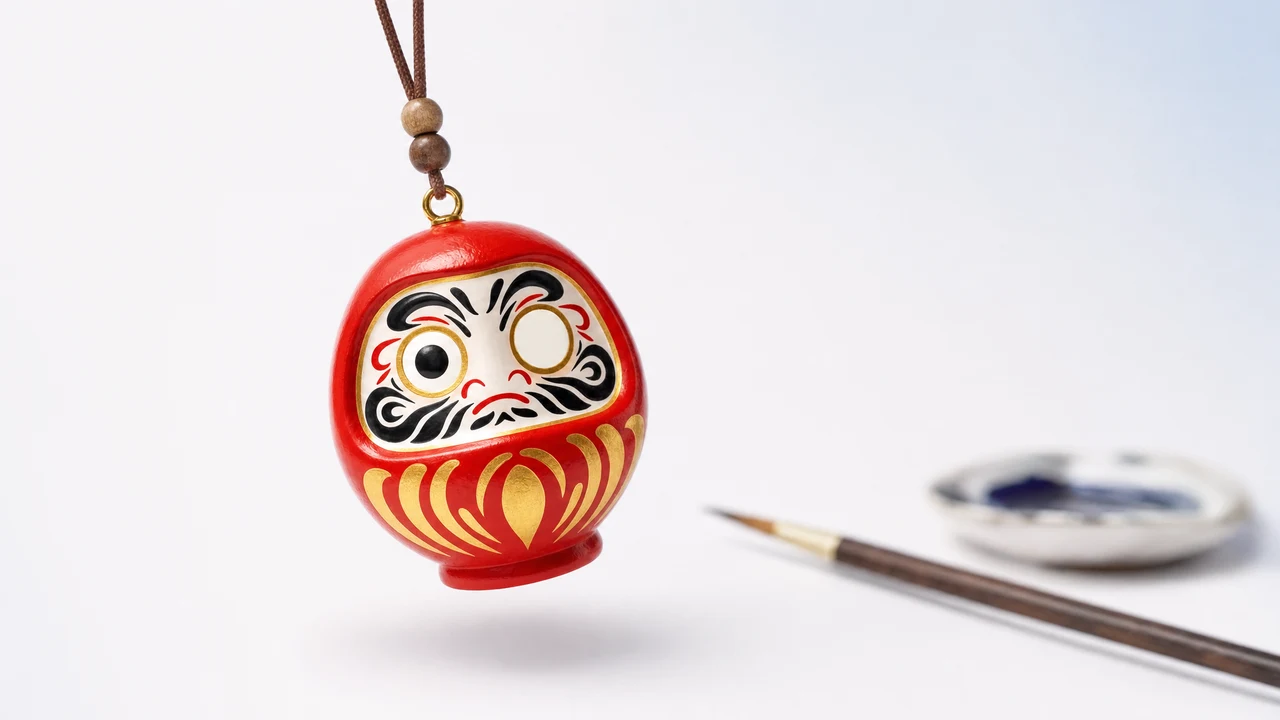
Daruma goal setting is a ritual where you paint in one of the doll's blank eyes when you commit to a goal, and paint the second eye only once you have reached it. The half-blind doll then sits in view as a quiet, daily reminder of a promise you have not yet kept.
Most goal advice ends at writing the goal down. The Daruma keeps working after that, because a lopsided face in your eyeline is far harder to ignore than a line in a document.
What is the Daruma eye ritual?
The Daruma is a round, red Japanese doll modelled on Bodhidharma, the founder of Zen, and it comes with both eyes blank. That blankness is the whole mechanism.
You paint the left eye when you set an intention, sealing the commitment. The right eye stays empty until the goal is done, at which point you fill it in and the face is finally whole. The deeper origin and meaning are in daruma doll meaning.
The doll is also weighted at the base, so when knocked over it rocks back upright, a nod to the proverb "fall down seven times, get up eight". A goal held by a Daruma carries that resilience in its shape.
The unfinished face is the point. A Daruma with one eye is a debt you can see, and a visible debt nags more usefully than a private one.
Why does painting one eye first work for makers?
Makers ship things, and shipping needs a commitment that survives the messy middle. The Daruma ritual is built for exactly that gap between starting and finishing.
Three things make it land.
It makes the commitment physical. Painting an eye is a small ceremony, and a ceremony feels more binding than a note. You did a thing, on purpose, to start this.
It stays in view. The half-painted doll sits on the desk or the shelf, so the goal is not something you have to remember; it is something you keep seeing. This is the anchoring idea from desk ritual, given a face.
It has a real ending. Most goals fizzle without a clear finish. The second eye is a defined, satisfying end point, so completion has a moment, not just a fade.
Choose a goal with a clear finish line before you paint the first eye. "Ship version one" or "submit the thesis" works; "get better at design" has no second-eye moment and leaves the doll half-blind forever.
How do you run Daruma goal setting as a maker?
The ritual is simple, but the choices around it decide whether it helps or just sits there.
Step one: pick one goal with a real end. One at a time. A shelf of half-eyed dolls dilutes the meaning until none of them nag.
Step two: paint the first eye, and say the goal out loud. The ceremony matters. Mark the start deliberately rather than in passing.
Step three: put the doll where you cannot miss it. Beside the monitor, not in a drawer. The whole power is in being seen daily.
Step four: leave the second eye blank until it is truly done. No early painting, no "close enough". The rule only works if you honour it, and the honouring is the discipline.
Step five: when it is done, paint the second eye. Make a small moment of it. A goal that ends with a mark ends properly, which makes the next one easier to start.
For a launch specifically, this pairs well with the day-of ritual in good luck charm for launch, and the daily focus that gets you there is in focus ritual.
Physical doll versus a Daruma charm on screen
You can run this with a paper-mâché doll or with a Daruma charm on your Mac. They suit different makers.
A physical Daruma doll
- Best for: goals you want to honour with a tangible object and a real brush.
- Upside: the ceremony of painting is genuinely felt.
- Downside: you have to buy one, keep it, and remember to look at it.
- Where it lives: on the desk, in the room.
A Daruma charm on screen
- Best for: makers who live in their Mac and want the reminder where they already look.
- Upside: always in view, no clutter, tied to milestones you can book.
- Downside: the painting is symbolic rather than a literal brushstroke.
- Where it lives: at the top edge of your screen.
Neither is more correct. The physical doll wins on ceremony; the screen charm wins on presence, because it is in the one place a maker never stops looking.
How the screen version works
Book My Luck hangs a charm from the top edge of your Mac screen on a thin cord with real rope physics. Choose the Daruma, and it becomes your goal marker: it sways, reacts to your cursor, and everything under it clicks straight through, so it never blocks the work that gets you to the finish.
Daruma goal setting steadies you and marks the commitment. It does not make the goal happen, the way a lucky pen does not finish the project. The Daruma tradition is treated with respect for what it means, not sold as a shortcut to success.
How big should a Daruma goal be?
Big enough to matter, small enough to finish in a season. A goal that takes a year leaves the doll half-blind for so long that it fades into the furniture, and one that takes an afternoon is not worth the ceremony.
The sweet spot is a few weeks to a few months. That range keeps the unfinished eye close enough to still nag without becoming background you stop seeing, which is the failure mode for goals set too far out.
If your real ambition is large, break it into Daruma-sized pieces. Ship the first version, then the next; submit the chapter, then the thesis. Each piece gets its own doll and its own second eye, so the finish line stays in sight the whole way, and you collect a run of small completions instead of chasing one distant one.
For a long project, keep one doll per milestone rather than a single doll for the whole thing. A shelf you slowly complete is more motivating than one face that stays half-blind for a year.
What if you never finish the goal?
Then the doll stays half-blind, and that is allowed to sting a little, honestly. The unfinished face is doing its job even when it is uncomfortable.
The Daruma tradition has a gentle answer, though. The proverb behind the weighted base is about getting up more times than you fall, so a goal missed is not a verdict; it is a fall you rise from. Set a new goal, paint a fresh first eye, and let the old lesson ride into the next attempt.
What is Daruma goal setting?
Daruma goal setting is a ritual where you paint one of the doll's blank eyes when you commit to a goal and the second eye only when you achieve it. The half-painted doll stays in view as a daily reminder of the unfinished promise.
Which eye do you paint first on a Daruma?
Traditionally you paint the left eye first when you set the goal, and the right eye when it is fulfilled. What matters most is doing it consistently and leaving the second eye blank until the goal is genuinely met.
Does the Daruma ritual actually help you reach goals?
It helps by making the commitment physical and keeping it in constant view, which is harder to ignore than a note. It does not guarantee the outcome, so treat it as a steadying reminder rather than a promise.
What happens if I do not finish the goal?
The doll stays half-blind, which is meant to be felt. The tradition frames a miss as a fall you get up from, so you set a new goal, paint a fresh first eye, and carry the lesson forward.
Book My Luck today
Book My Luck is a desktop decoration for macOS 14+ and Windows 10/11. The desktop outside the charm remains clickable. The current Mac and Windows downloads are version 1.0.32, signed by KAK DIGITAL LLC. On Mac, Charm Centre controls size, cord length, placement, displays and motion. Collections and controls can differ between Mac and Windows.
There is no calendar integration, booked-moment scheduler or native-app free trial. Explore the website demo and regional pricing. One key activates one computer at a time; activation and license refresh require internet. Preferences are local, but purchasing, activation and website analytics use online services described in the privacy policy.
Hang one for the moment that matters
Book My Luck hangs a rendered charm from your Mac or Windows screen, with rope physics and manual interaction. Check the current platform release and regional price before buying.
Get Book My Luck →