Book My Luck
Why a Physical Cue Beats Another Notification
A physical cue beats another notification because it anchors a habit to a stable signal you notice without being nagged, while a notification demands a response and gets buried under all the others. An anchoring habit cue is something you see, touch, or hear on purpose; a notification is something that interrupts you whether you asked for it or not.
Most habit apps assume the problem is forgetting, so they add more alerts. The real problem is that alerts stopped working, and adding more of them makes it worse.
What is an anchoring habit cue?
An anchoring habit cue is a consistent signal you attach an action to, so the signal starts to trigger the action on its own. The classic framing pairs an existing anchor, a moment or object already in your day, with the new behaviour you want.
The word anchor matters. The cue has to be stable, something that shows up reliably in the same context, or the habit has nothing firm to tie to.
A doorway, a kettle switch, the first sip of coffee, a charm swaying at the top of the screen, these make good anchors because they are always there and always mean roughly the same thing. Stability is the whole point.
A cue that changes every day is not an anchor. It is just more noise wearing a helpful costume.
The habit-forming side of this is explored in desk ritual. Here the question is narrower: why does a physical or ambient anchor beat a push notification for the same job?
Why do notifications stop working?
Notifications fail for reasons that are structural, not fixable by better wording or timing. Three of them do most of the damage.
They demand, they do not remind. A notification is a small task: read me, dismiss me, act on me. Every one adds to a pile, and a reminder that adds work is a reminder you learn to resent.
They stack until they blur. When everything pings, nothing stands out. Your brain does the sensible thing and tunes the whole channel down, taking your important cue down with it.
They train dismissal. Swiping a notification away becomes a reflex faster than the habit it was meant to trigger. You get very good at ignoring the exact thing you set up to notice.
The more notifications you add to enforce a habit, the faster your brain learns to dismiss that whole category on autopilot. You end up training the opposite of what you wanted.
There is a quieter cost too. Notifications arrive on someone else's schedule and yank your attention sideways, which is the last thing you want from a cue meant to start focused work.
Physical cue versus notification
The two do the same job on paper and opposite jobs in practice. Laid side by side, the difference is stark.
Physical or ambient cue
- How you meet it: you glance at it or touch it, on your terms.
- What it costs: nothing; it is just present.
- Over time: it fades into the background until you look, then it means something.
- Failure mode: you stop noticing it, but it never nags.
Push notification
- How you meet it: it interrupts, on its schedule.
- What it costs: a small decision every single time.
- Over time: it blurs into the pile and gets tuned out.
- Failure mode: you dismiss it reflexively, habit and all.
The physical cue's worst case is that you ignore it. The notification's worst case is that it trains you to ignore a whole channel and adds stress on the way. Those are not the same kind of failure.
What makes a physical cue land?
Not every object works as an anchor. A good physical cue shares a few traits, and they are the mirror image of what makes notifications fail.
Glanceable. You take it in at a look, with no reading and no decision. Its meaning is instant.
Calm. It does not demand a response, so it never becomes a task. Presence, not pressure.
Consistent. It sits in the same place and means the same thing, so the anchor holds.
Tied to a moment. It shows up right when the habit should, not at a random time chosen by an algorithm.
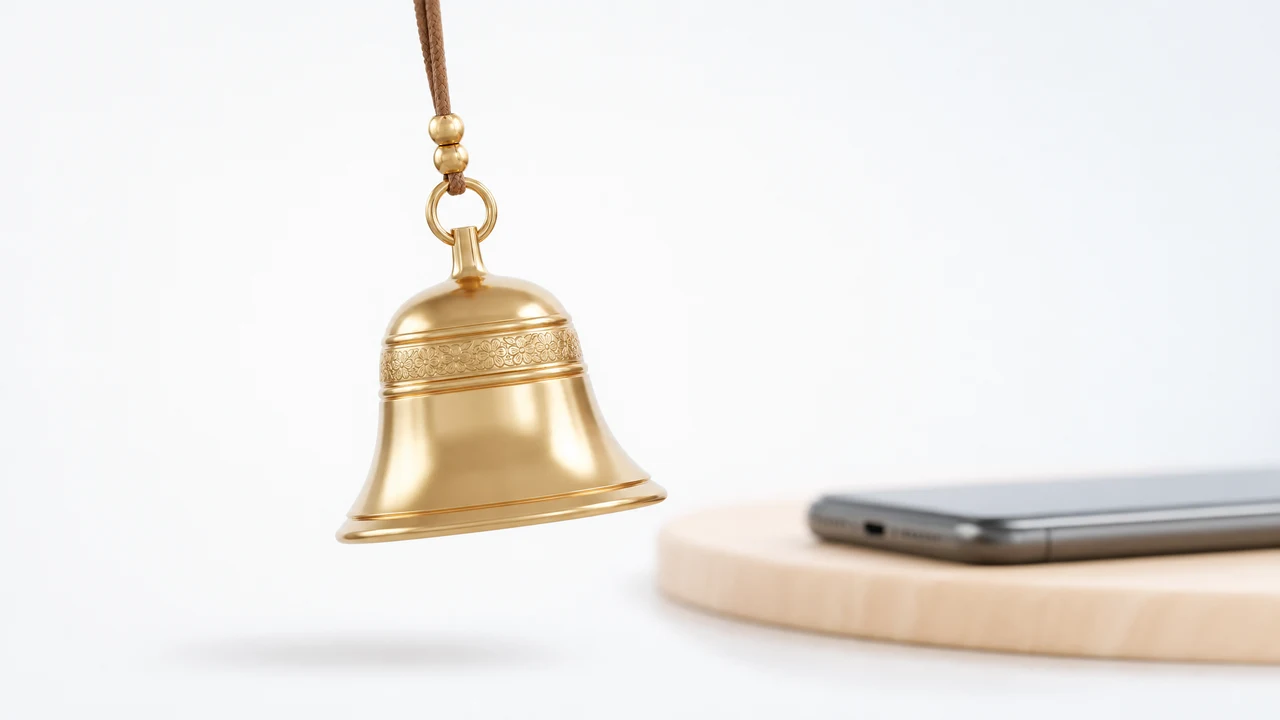
A bell rung once before work is a fine example, calm, glanceable in sound, tied to the moment you begin. The full case for it is in ring a bell before work, and a wider menu is in pre-work ritual ideas.
How a swaying charm becomes an anchor
A charm hanging from the top of your screen is close to an ideal anchoring habit cue. It is present without pinging, glanceable without reading, and it can be tied to an exact moment.
Book My Luck hangs a charm from the top edge of your Mac screen on a thin cord with real rope physics. It sways, reacts to your cursor, and can be grabbed and flicked, while everything under it clicks straight through so it never interrupts your work.
A charm is a cue, not a promise. It anchors a habit and steadies you, the way a lucky pen marks a moment without writing the words. It will not do the work or change an outcome, and the traditions behind each charm are treated with respect.
If a one-time, calm anchor that never adds to your notification pile sounds better than another alert, the pricing page has the plain details. The focus-specific version of this cue is in focus ritual.
How long does an anchoring cue take to set?
A couple of weeks of consistent pairing, in most cases. The cue and the action have to co-occur enough times for your brain to wire them together, and that wiring is built by repetition, not by trying harder.
The speed depends on how tightly you pair them. A cue that reliably fires at the same moment, right before the same action, sets faster than a loose one, because tight pairing teaches the brain quickly while a sloppy one leaves it guessing.
Expect the first days to feel like nothing is happening. The link forms quietly underneath awareness, and then one day you notice the cue is already pulling the action along before you have decided to act. That shift is the anchor doing its job, and the habit runs itself from there.
Do not judge an anchor in its first week. The connection is forming even when you cannot feel it, and quitting early throws away the repetitions that were about to pay off.
Should you turn off notifications entirely?
Not necessarily; some genuinely need to interrupt you, like a meeting starting or a person calling. The point is not zero notifications, it is not using notifications for the wrong job.
Reserve pings for things that truly must break your attention, and hand the gentle, recurring cues, start work, take a breath, mark the moment, to a calm anchor instead. Split that way, each tool does what it is actually good at, and you stop training yourself to ignore your own reminders.
What is an anchoring habit cue?
An anchoring habit cue is a stable, repeated signal you tie an action to, so the signal starts to trigger the action on its own. Good anchors are things already present in your day, like a kettle switch, a doorway, or a charm on your screen.
Why do notifications stop working for habits?
Notifications demand a response, stack up until they blur together, and train you to dismiss them on reflex. Over time your brain tunes out the whole channel, taking the reminder you cared about with it.
Is a physical cue really better than a reminder app?
For gentle, recurring habits, yes, because a physical or ambient cue is glanceable, calm, and never adds a task. Reminder apps still have their place for things that genuinely must interrupt you, like a call or a meeting.
Can I use both notifications and physical cues?
Yes, and that is the sensible split. Keep notifications for things that must break your focus, and use a calm anchor for the recurring, gentle cues so you stop diluting your own alerts.
Book My Luck today
Book My Luck is a desktop decoration for macOS 14+ and Windows 10/11. The desktop outside the charm remains clickable. The current Mac and Windows downloads are version 1.0.32, signed by KAK DIGITAL LLC. On Mac, Charm Centre controls size, cord length, placement, displays and motion. Collections and controls can differ between Mac and Windows.
There is no calendar integration, booked-moment scheduler or native-app free trial. Explore the website demo and regional pricing. One key activates one computer at a time; activation and license refresh require internet. Preferences are local, but purchasing, activation and website analytics use online services described in the privacy policy.
Hang one for the moment that matters
Book My Luck hangs a rendered charm from your Mac or Windows screen, with rope physics and manual interaction. Check the current platform release and regional price before buying.
Get Book My Luck →