Book My Luck
Lucky Charm for a Wedding Speech
A lucky charm for a wedding speech is a small object you keep close so your nerves settle and your words land as warmly as you meant them. It does not write the speech or guarantee laughs; it steadies the person holding the microphone.
Most advice about speeches is all technique and no nerves. The missing half is that shaking hands and a dry mouth undo good preparation, and a charm is a quiet tool for exactly that.
What does a charm do before a speech?
A charm gives you one familiar thing to hold in a room full of eyes. You touch it, you breathe, and the spike of stage fright drops enough to let you begin.
That is the whole benefit. The charm does not perform; it settles the performer so the rehearsed words can come out.
Public speaking nerves are physical: a racing heart, a tight throat, a mind that goes blank. A charm is a fixed cue that says you know this, just start, which is the sentence people lose the moment they stand.
A lucky charm for a wedding speech works like a lucky pen in an exam. It marks the moment and steadies you; the words are still yours.
Why does the endless knot suit a wedding?
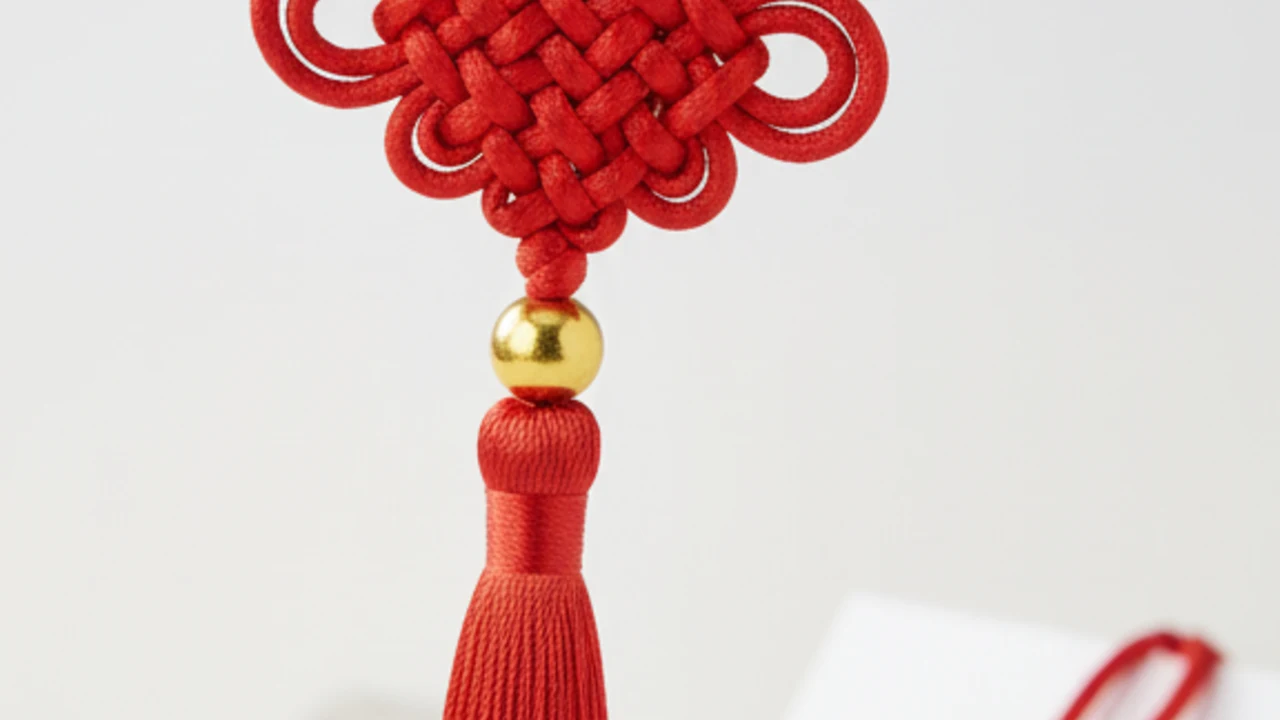
The Pánchāng jié, the Chinese endless knot, is a single cord looped so it has no beginning and no end. It is a long-standing symbol of continuity and connection, of things that carry on unbroken.
That is a lovely emblem for a wedding. The knot speaks to the union you are there to celebrate, and holding one before you speak keeps that meaning close.
It is also a calming object to handle, a cord you can trace with a thumb while you wait for your cue. The symbolism and the fidget do the same steadying job at once.
The endless knot's meaning here is continuity and lasting connection, drawn from its real origin. It is a fitting charm to hold at a wedding precisely because of that story.
How do I use a charm on the day?
Keep it small and private, and run the same short routine right before you rise. Nobody in the room needs to know the charm is there.
Try this in the minute before your name is called.
- Find the charm in your pocket or hand.
- Take one slow breath, longer on the way out.
- Give yourself a plain line: this is a happy room, and they want me to do well.
That last thought is true and it helps. A wedding crowd is the friendliest audience you will ever face, and reminding yourself of that lowers the fear.
Practise the opening line more than any other. Nerves peak in the first ten seconds, and a memorised, warm opener carries you past the worst of them.
The steadying mechanism is the same one you would use before a presentation at work or a nerve-wracking interview. The occasion is warmer; the tool is identical.
Which charms fit a wedding moment?
The endless knot is the natural choice, but a few others carry the right feeling. Each has a real story behind it.
Pánchāng jié, the endless knot
- Origin: China, the Chinese endless knot.
- The idea: a single unbroken cord, a symbol of lasting connection.
- Why it fits: it speaks directly to the union being celebrated.
Elephant, trunk up
- Origin: India and Southeast Asia.
- The idea: the raised trunk is a sign of good fortune and blessing.
- Why it fits: it is a warm emblem of good wishes for the couple.
Four-leaf clover
- Origin: Ireland.
- The idea: the rare fourth leaf stands for luck and a private wish.
- Why it fits: it is a small, hopeful token to tuck away before you speak.
Pick the story that moves you. A charm with meaning is one your nerves will actually respond to at the top table.
Does a charm make the speech better?
Not directly, and it would be false to say it did. A charm changes your state, and your state is what shapes how the words come out.
A calmer speaker breathes, pauses, and makes eye contact instead of racing to the end. Those habits are what make a speech feel warm rather than rushed, and they come from your nerves settling.
So the charm is a steadying aid, not a script. Write from the heart, practise the opening, and let the charm handle the shakes.
A charm is no substitute for preparation. If the speech is unwritten or unrehearsed, no token will save the moment, so do the work first.
Where should the charm live before the day?
Somewhere it steadies you while you rehearse, so it is tied to the speech and not just the venue. That is what turns an ornament into a working cue.
Some keep the knot in a jacket pocket. Others keep the charm on their Mac while they draft and practise, where a scheduled reminder can bring it forward.
Format is a matter of taste. A pocket knot and a screen charm both give you the same steadying breath, which is the only job a speech charm has.
A short comparison of charm formats
| Format | Best for | The catch |
|---|---|---|
| Pocket token | A discreet squeeze before you stand | Easy to leave in the wrong jacket |
| Worn charm | A steady presence through the meal | Others may notice it |
| Screen charm | Rehearsal cue set for the reception | Lives on your Mac, not the table |
No row is correct for everyone. Choose the one you will reliably have with you on the day.
What if my voice shakes anyway?
A shaky voice is normal, and the room forgives it instantly at a wedding. Nobody there is grading your delivery; they are on your side and hoping you do well.
If the nerves win the first line, pause, hold the charm, and take one slow breath before the next. That small reset is why you carry it, and one steadying breath recovers more speeches than any clever joke.
Speak a little slower than feels natural, because nerves speed everyone up. A calm, unhurried toast that means what it says beats a rushed, polished one, and warmth over polish is what people remember the next morning.
What is a good lucky charm for a wedding speech?
The Chinese endless knot suits the occasion because its unbroken cord symbolises lasting connection, and it is calming to hold. Any small token with a story you like works, since the charm's real job is to steady your nerves.
Do lucky charms help with speech nerves?
They help indirectly by giving you a familiar object to hold and a fixed ritual to run, which lowers stage fright. A charm cannot write or deliver the speech; it simply helps you begin as the calmer version of yourself.
Why is the endless knot linked to weddings?
The Chinese endless knot is a single cord with no beginning or end, long used as a symbol of continuity and connection. That meaning maps neatly onto the union a wedding celebrates.
How do I calm down right before I speak?
Hold your charm, take one slow breath with a longer exhale, and remind yourself that a wedding crowd is on your side. Rehearsing the opening line also matters, since nerves peak in the first few seconds.
Can I use an app instead of a physical charm?
Yes. A screen charm can hang on your Mac during rehearsal and be timed to the reception, giving you the same steadying cue as a pocket token.
Is it strange to use a charm for a speech as an adult?
Not at all. Speech nerves are near-universal, and a small calming ritual is closer to a breathing exercise than a superstition, which is why plenty of confident speakers keep one.
Book My Luck is a one-time purchase with no subscription, and you can read the full pricing before deciding. It is a charm, not a promise: it will not deliver the toast for you, but it can help your words come out as warm as you feel.
Book My Luck today
Book My Luck is a desktop decoration for macOS 14+ and Windows 10/11. The desktop outside the charm remains clickable. The current Mac and Windows downloads are version 1.0.32, signed by KAK DIGITAL LLC. On Mac, Charm Centre controls size, cord length, placement, displays and motion. Collections and controls can differ between Mac and Windows.
There is no calendar integration, booked-moment scheduler or native-app free trial. Explore the website demo and regional pricing. One key activates one computer at a time; activation and license refresh require internet. Preferences are local, but purchasing, activation and website analytics use online services described in the privacy policy.
Hang one for the moment that matters
Book My Luck hangs a rendered charm from your Mac or Windows screen, with rope physics and manual interaction. Check the current platform release and regional price before buying.
Get Book My Luck →